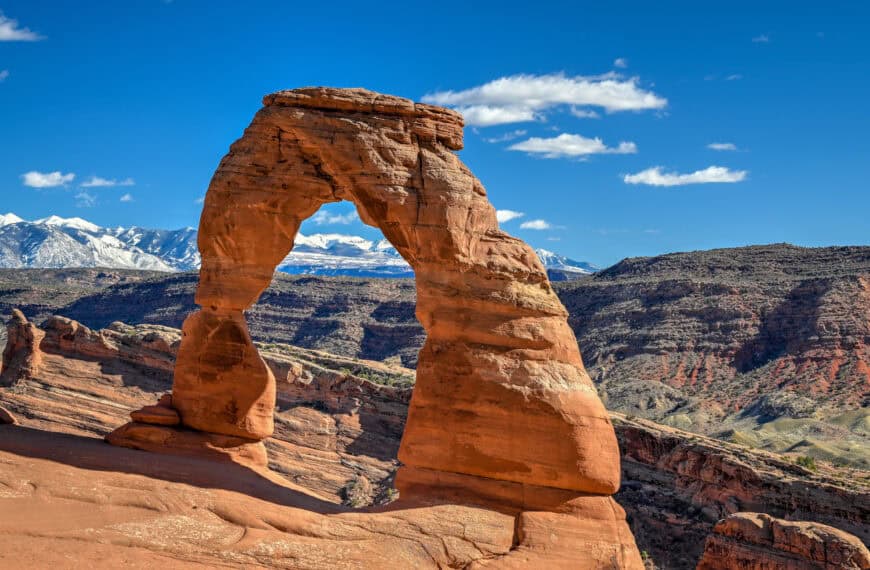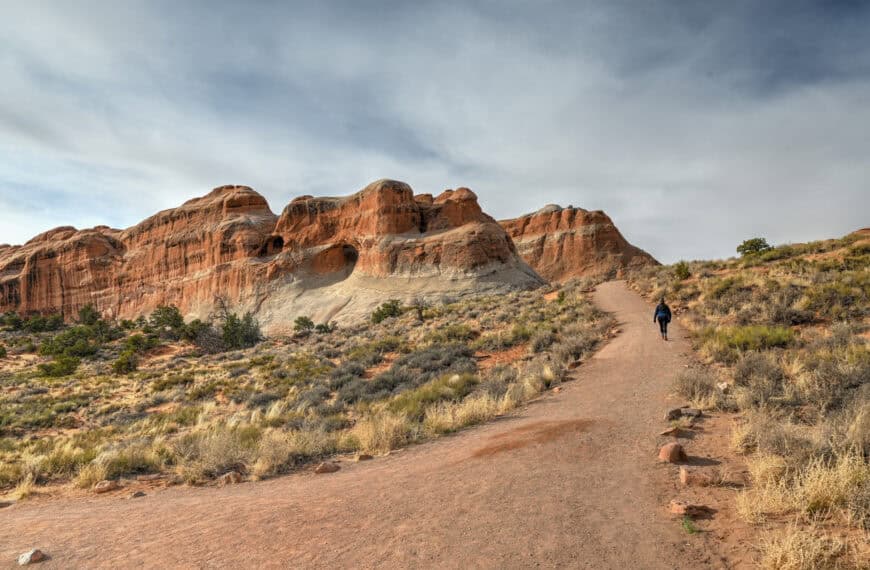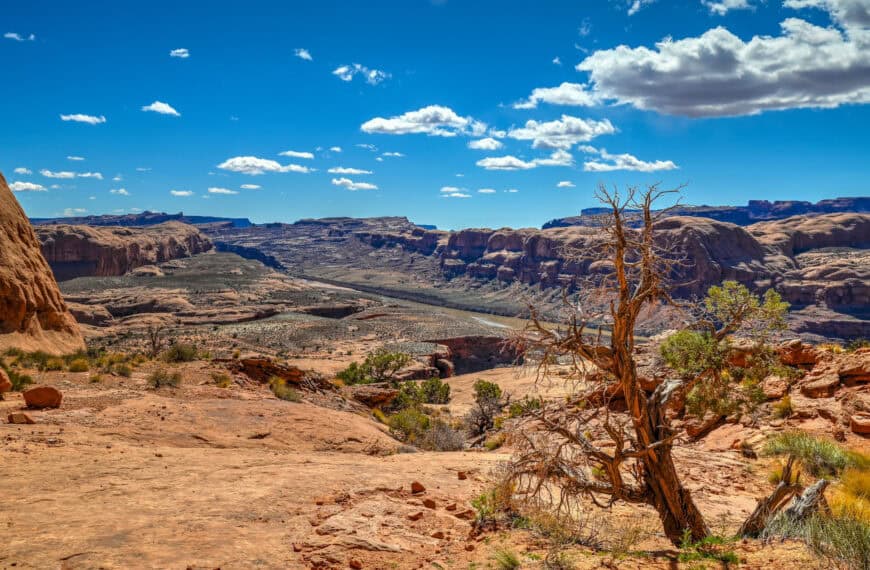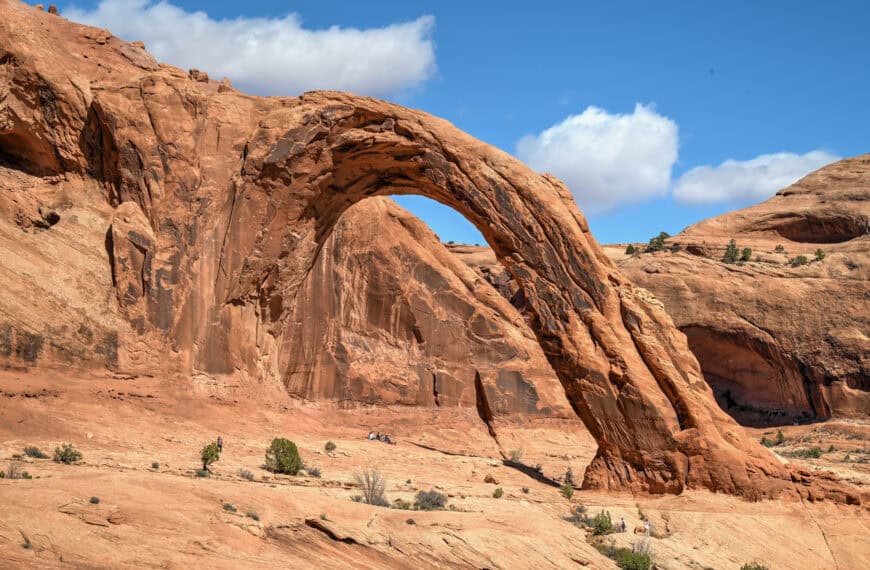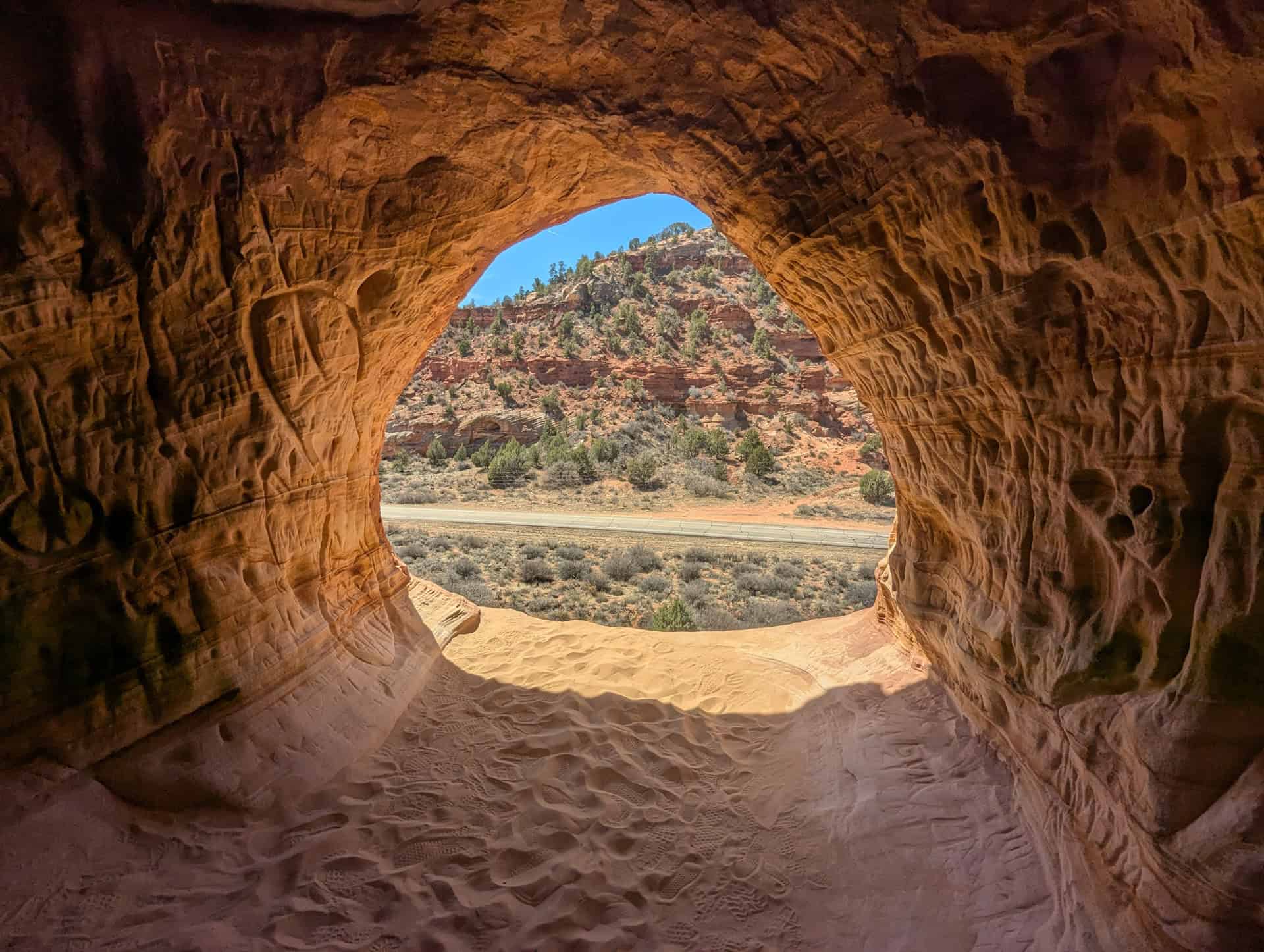
The Moqui Sand Caves, just outside Kanab, Utah, offer a unique hiking experience through a series of small, hand-carved sandstone caves tucked into the red rock landscape. This short but adventurous trail winds across slickrock, sandy washes, and narrow passageways, making it an ideal hike for families, photographers, and outdoor enthusiasts alike. With easy access from Kanab, dramatic desert scenery, and the opportunity to explore the caves themselves, the Moqui Sand Caves Trail is a standout stop in southern Utah’s vast red rock country. In this guide, you’ll find everything you need to plan your visit—from trail details and route tips to parking info, best times to go, and what to expect along the way.
Moqui Sand Caves Trail – At a Glance
A Quirky Desert Adventure – The Moqui Sand Caves Trail leads hikers to a cluster of unusual man-made caverns carved into red sandstone near Kanab. Created in the 1970s when sandstone was mined for glass production, the caves now offer a playful and slightly adventurous experience, perfect for climbing, exploring, and photographing the unique interiors.
Short but Rewarding – Though the hike is relatively brief, the combination of sandy trails, rock ledges, and the caves themselves makes it feel far more immersive than its distance suggests. Most visitors can complete the full trail in under an hour, leaving plenty of time to linger in and around the caverns.
Essential Kanab Hike – Ideal for visitors seeking a quick outdoor excursion, the Moqui Sand Caves Trail combines desert scenery, unusual geological features, and hands-on exploration in a single, compact outing. It’s a fun and memorable stop on any Kanab or southern Utah itinerary.
Photographer’s Delight – The contrast between the vibrant red sandstone, soft desert sands, and the deep shadows inside the caves creates striking photo opportunities. Early morning or late afternoon light enhances the rock’s textures and makes the colors pop.


Disclosure: This page (Moqui Sand Caves Trail – A Kanab Hiking Guide) may contain product affiliate links. At no additional cost to you, we may receive a commission for purchases made through these links. More details can be found on our disclosure and policies page.
Moqui Sand Caves Trail – Location and Map
The Moqui Sand Caves Trail is located just outside Kanab, Utah, in the scenic red rock desert of southern Utah. Nestled among sandstone cliffs and open desert terrain, this area is known for its striking red rock formations, expansive views, and unique man-made caverns. The trail is easily accessible by car, with a small parking area at the trailhead, and serves as a perfect short hike or half-day adventure for visitors exploring the Kanab region or travelling between Zion National Park and Page.
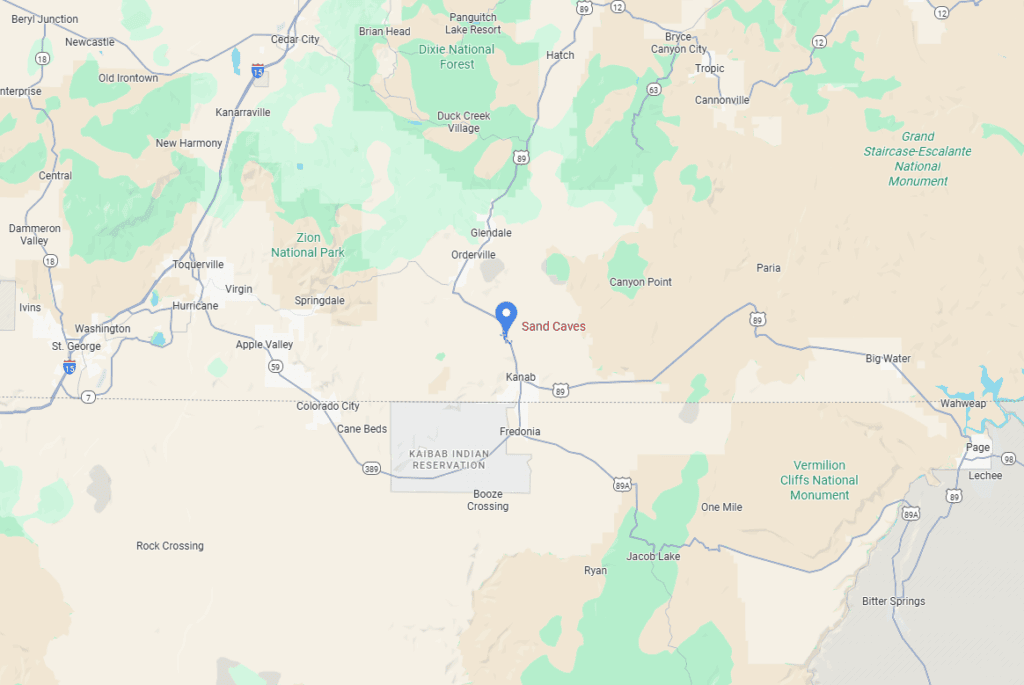
How to Get to Moqui Sand Caves
The Moqui Sand Caves Trail is best reached by car, as there is no public transportation to the trailhead.
Driving times to Valley of Fire State Park
- Kanab, UT: 10 km / 6 mi – about 10 minutes
- Zion National Park (Springdale, UT): 55 km / 35 mi – about 1 hour
- Page, AZ: 120 km / 75 mi – about 1h15
- St. George, UT: 120 km / 75 mi – about 1h30
- Las Vegas, NV: 320 km / 200 mi – about 3h
These times assume clear weather and normal traffic conditions.
If you need to book a rental vehicle for your hiking excursion, we highly recommend using Discover Cars to get the best rates on your rental in Utah, Nevada and Arizona.
We also highly recommend Airalo (eSIM card) for your connectivity needs when travelling abroad. Airalo is the world’s first and largest eSIM store with eSIM plans for 200+ countries and regions worldwide.
Moqui Sand Caves Trail – Trailhead, Parking & Fees
Trailhead Location: The Moqui Sand Caves Trail begins just off Highway 89, a short drive north of Kanab, Utah (link to Google Maps).
Trailhead parking lot: There is a new and very large designated unpaved parking area on the east side of the highway, next to the trailhead. Despite its size, it can fill up quickly on weekends and during peak travel seasons. However, turnover is fairly quick given the short length of the trail.
Facilities: When we last visited, there were portable toilets located near the car park.
Trail opening Hours: The trail is accessible from sunrise to sunset, as it is located on public land near Kanab. There are no formal park gates, but hiking outside daylight hours is not recommended for safety. It’s neither a popular place for sunrise nor sunset, as there are no viewpoints of the horizon
Entrance Fees: There are no entrance fees to hike the Moqui Sand Caves Trail. The hike is completely free.
Moqui Sand Caves Trail – Stats and Map
Distance: 1.2 miles (1.9 km)
Route Type: Out-and-back
Elevation gain: 120 ft / 36 m (cumulative elevation gain)
AllTrails rating (2025): 4.6, 4812 ratings
Duration: Most people complete the full trail in 30-45 minutes
Trail difficulty level assessment:
Very Easy | Easy | Moderate | Moderately Challenging | Challenging
Overall, the Sand Caves Trail is best described as Easy. The first half of the trail is very easy, but it gets trickier during the second half due to some light scrambling (with the help of a fixed rope) and uneven sections on slickrock that require sure footing.
Moqui Sand Caves Trail – Description and Summary
From the west side of the parking area, the route begins on an easy-to-follow sandy path that briefly descends into a shallow wash. The trail is braided here, but all the variations wind in the same general direction, staying just below the sandstone cliffs and parallel to the highway. After a few minutes, you’ll start spotting the cave openings perched above the slope to your right.


Continue past the caves for a short distance until you reach the base of a broad slickrock ramp. This is where the trail transitions from walking to light scrambling. The key to the ascent is picking a gradual angle rather than heading straight up. Most hikers use the well-worn line marked by a fixed rope, which helps on the slightly steeper section just below the ledge. The sandstone offers excellent friction, and as long as you’re comfortable descending what you climb, it’s straightforward for most visitors.


Once you top out on the slickrock, turn right and follow the narrow but manageable sandstone ledge toward the main cavern. This traverse includes a few mildly exposed spots, but the footing is good, and the ledge widens as you approach the caves.


Within a few minutes, you’ll step into the first of several large chambers: tall, airy, and surprisingly deep. The caves stretch roughly 300 feet end-to-end, with multiple interconnected “rooms,” carved windows, and sandy floors that stay cool even on hot days.


Inside, you can roam freely, admire the sculpted walls, and step out onto openings overlooking Kanab and the surrounding cliffs. A flashlight (or phone light) is useful if you want to explore the darker back sections. Please avoid adding graffiti—older markings are unfortunately common, and preserving the site is an ongoing challenge.
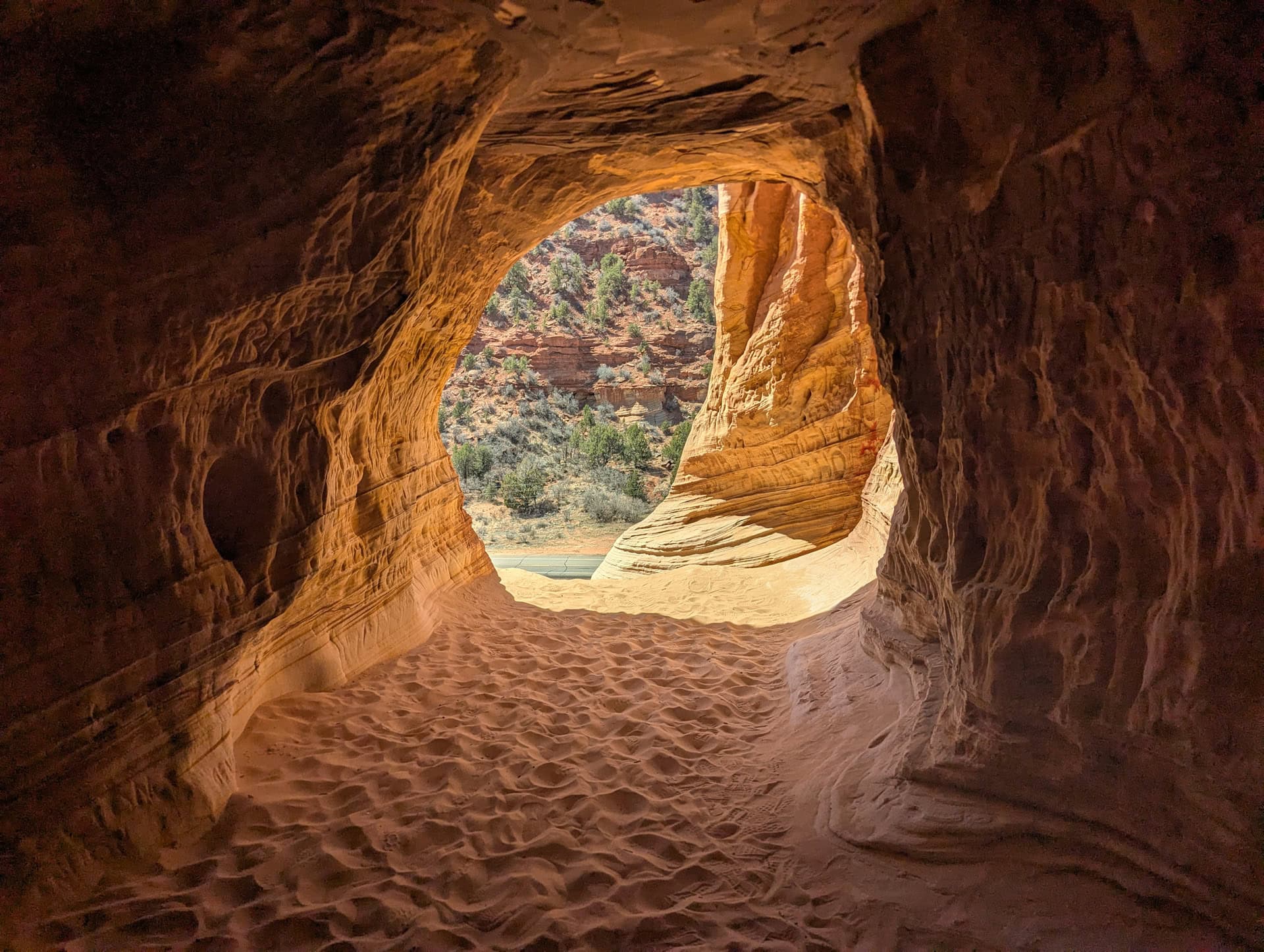
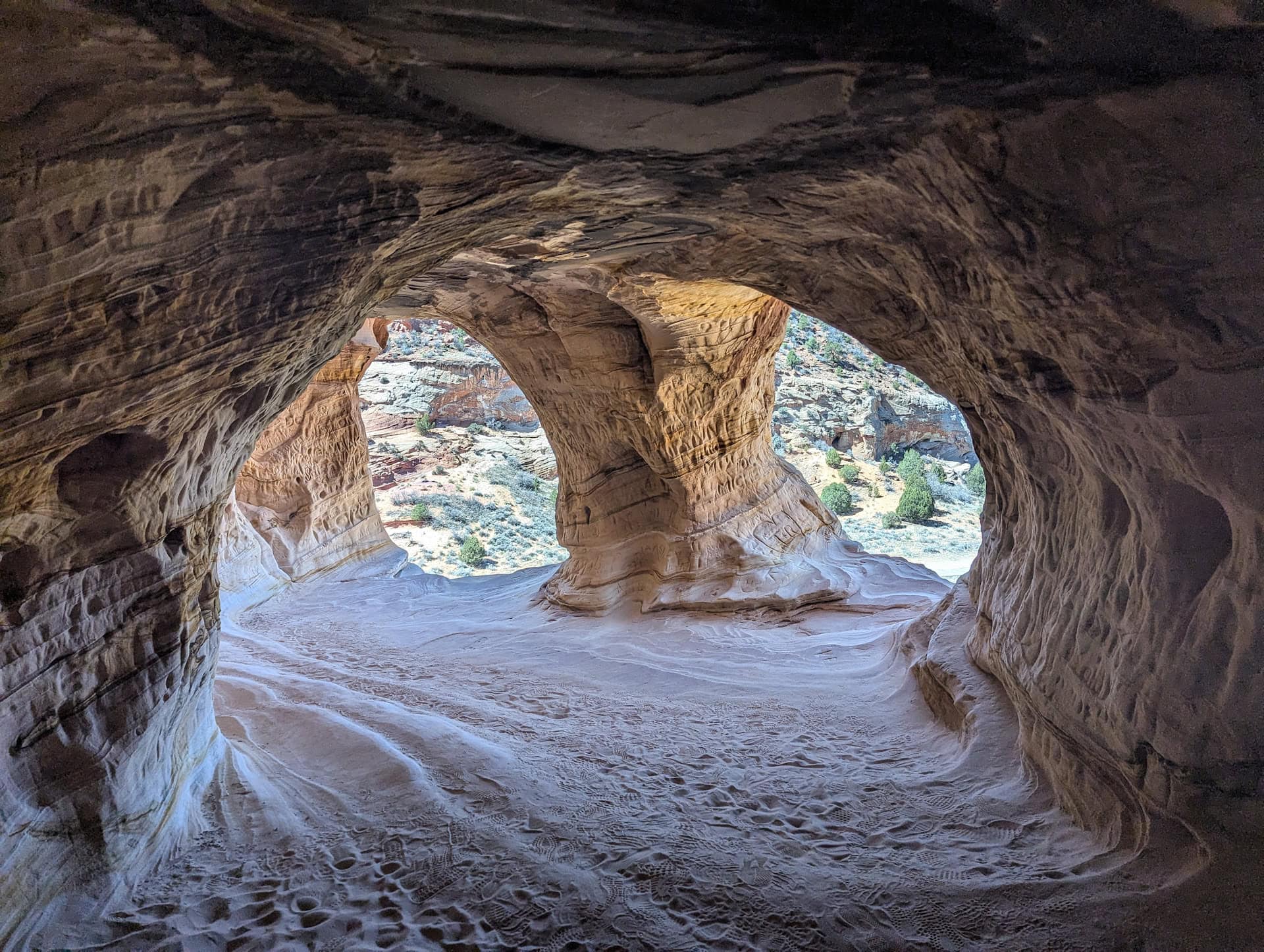
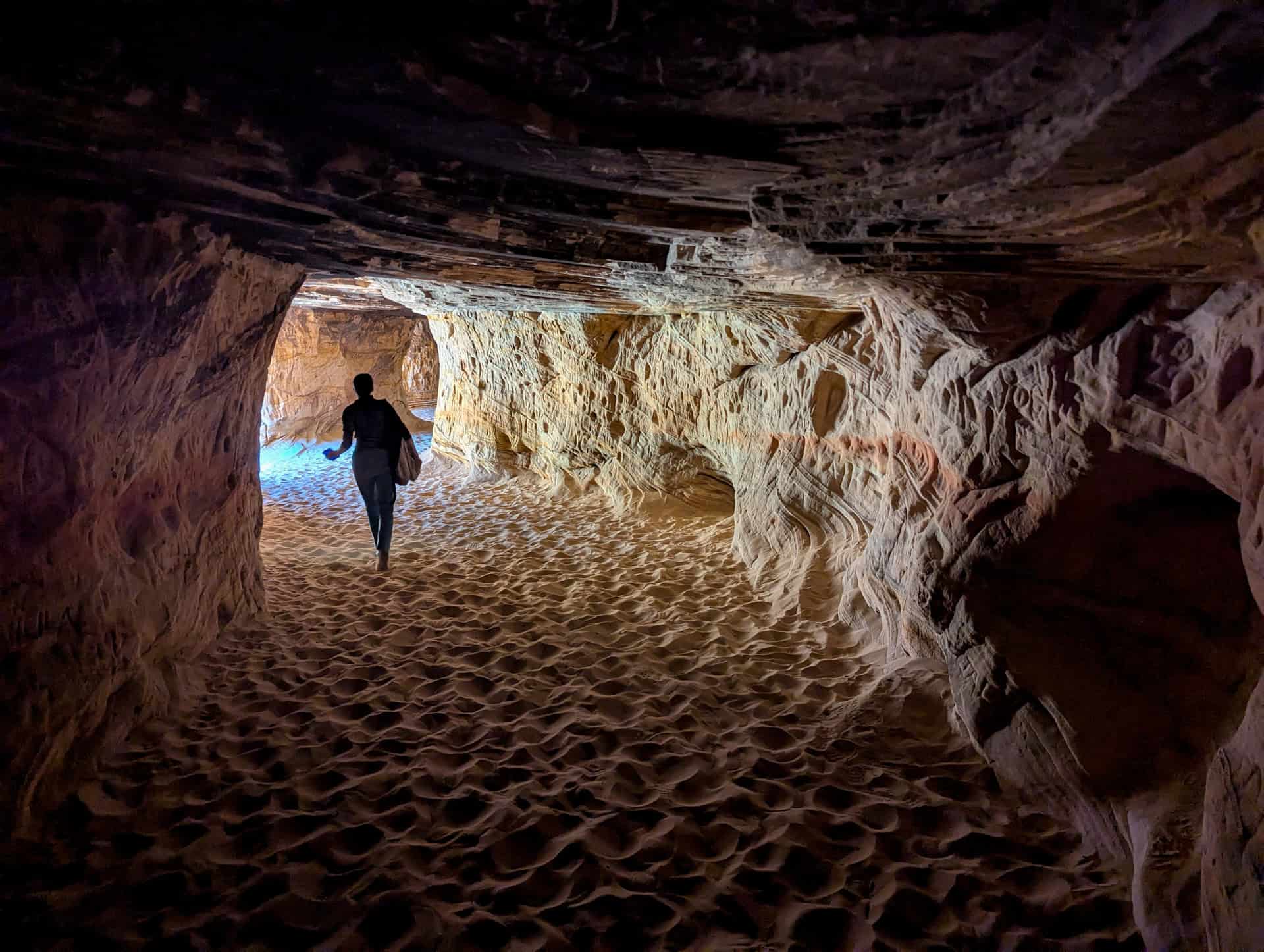
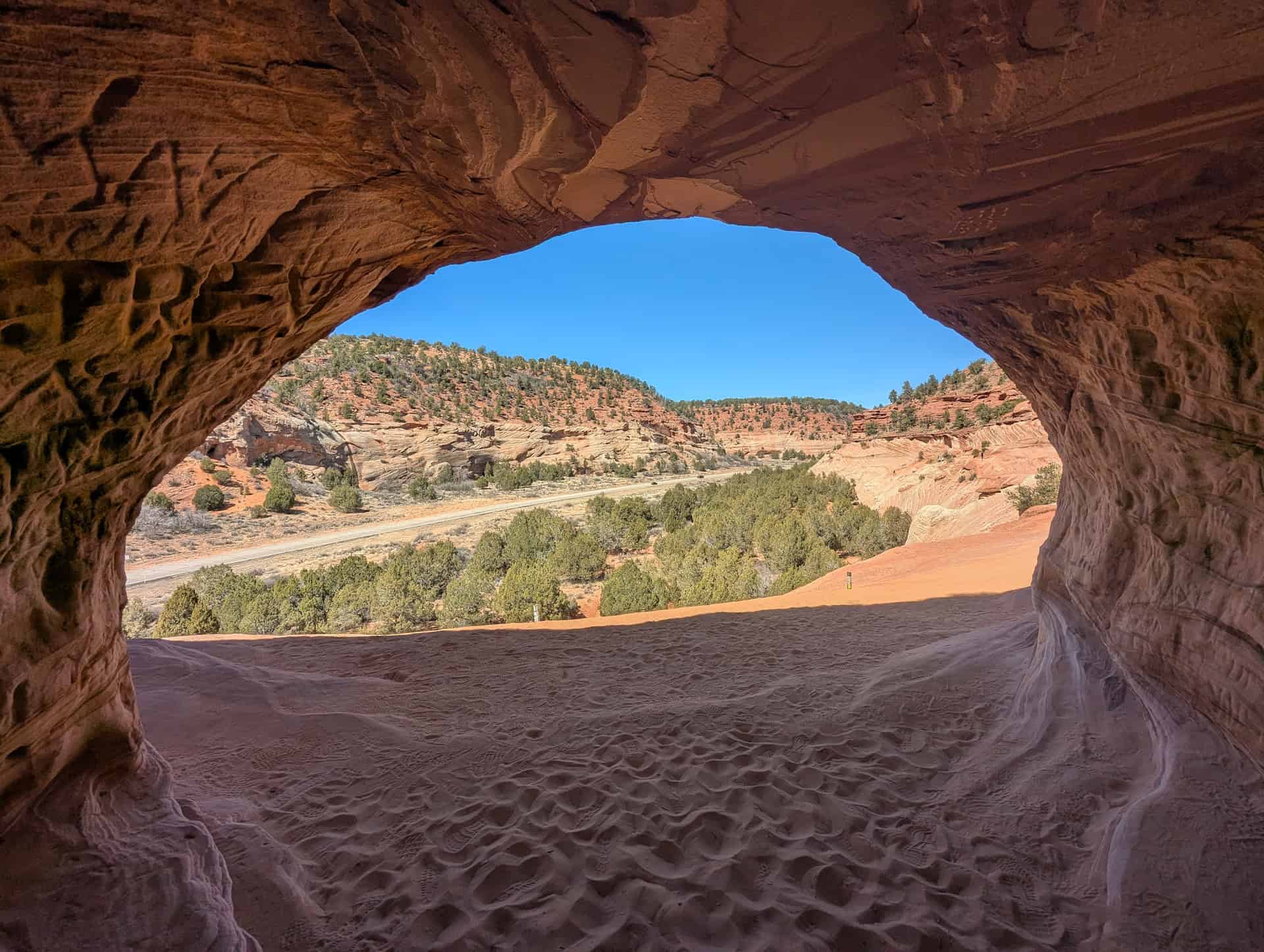
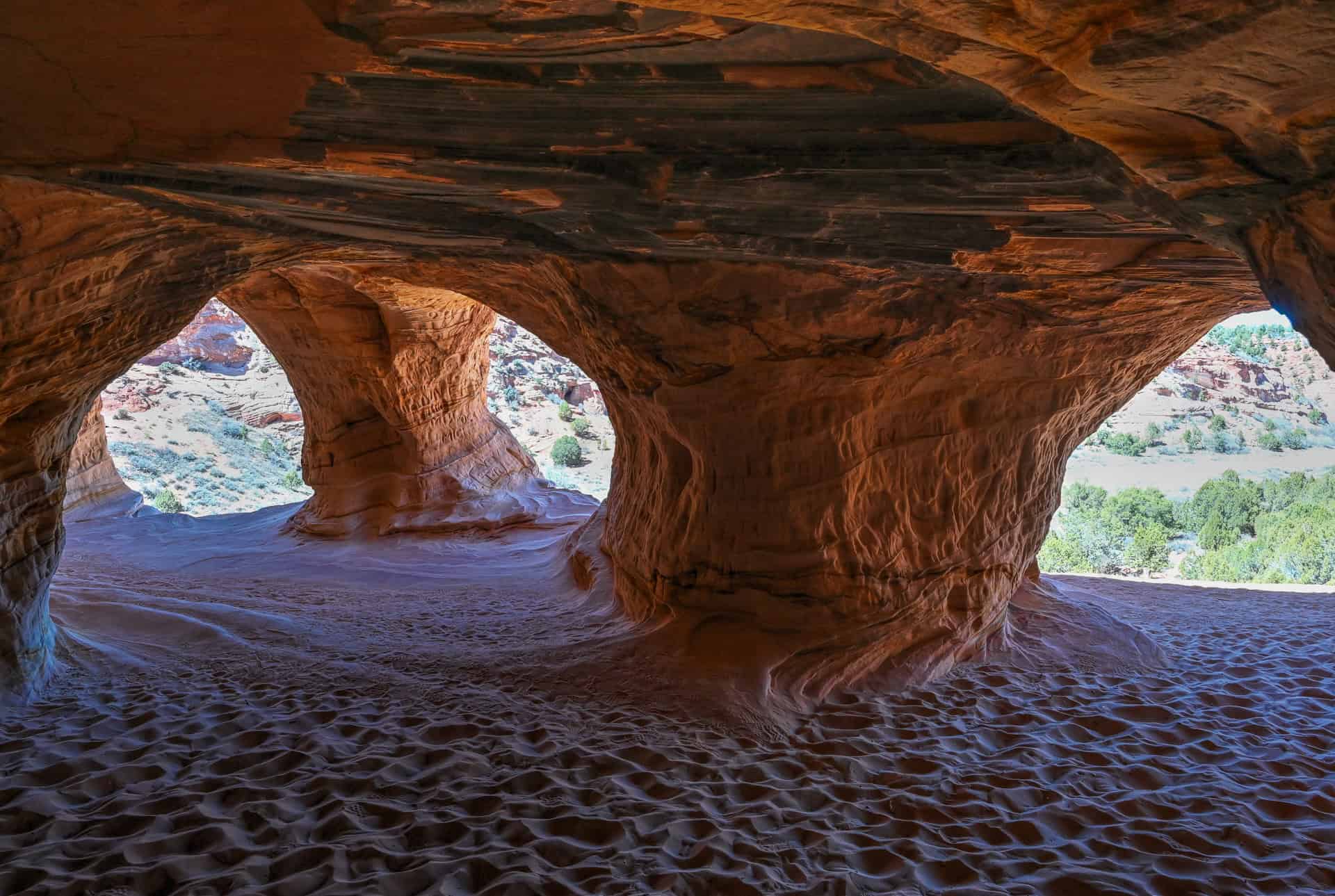
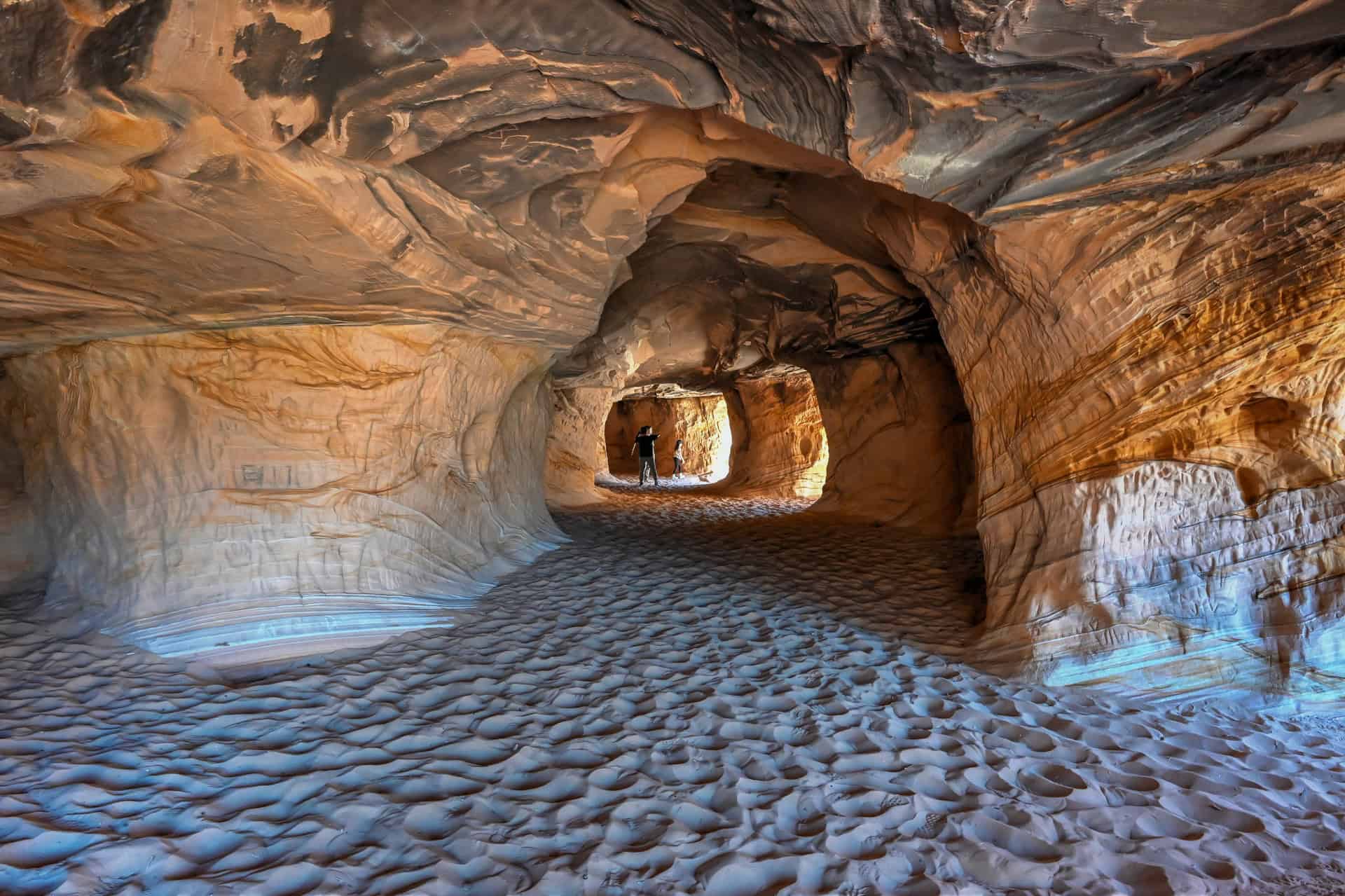
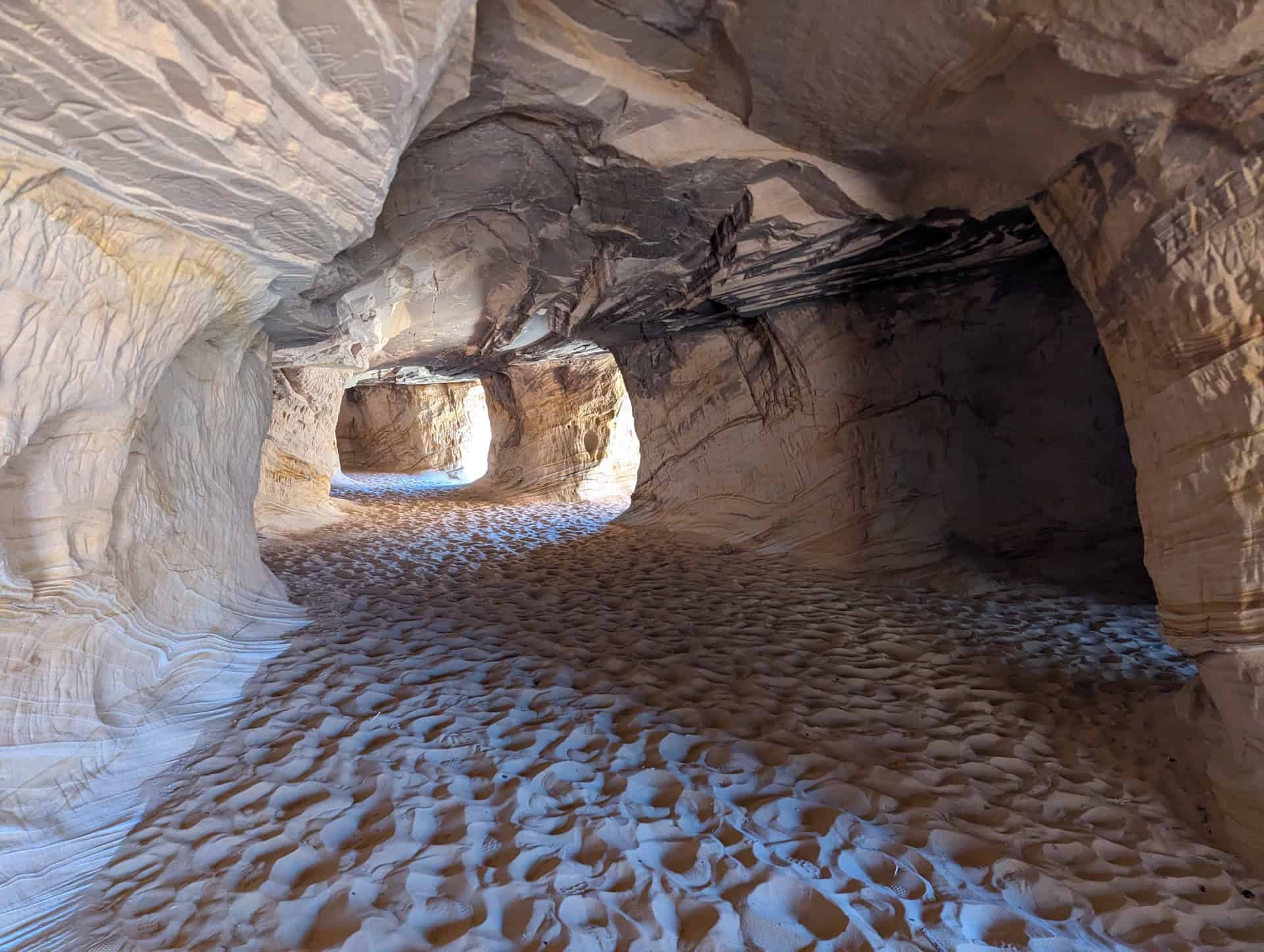
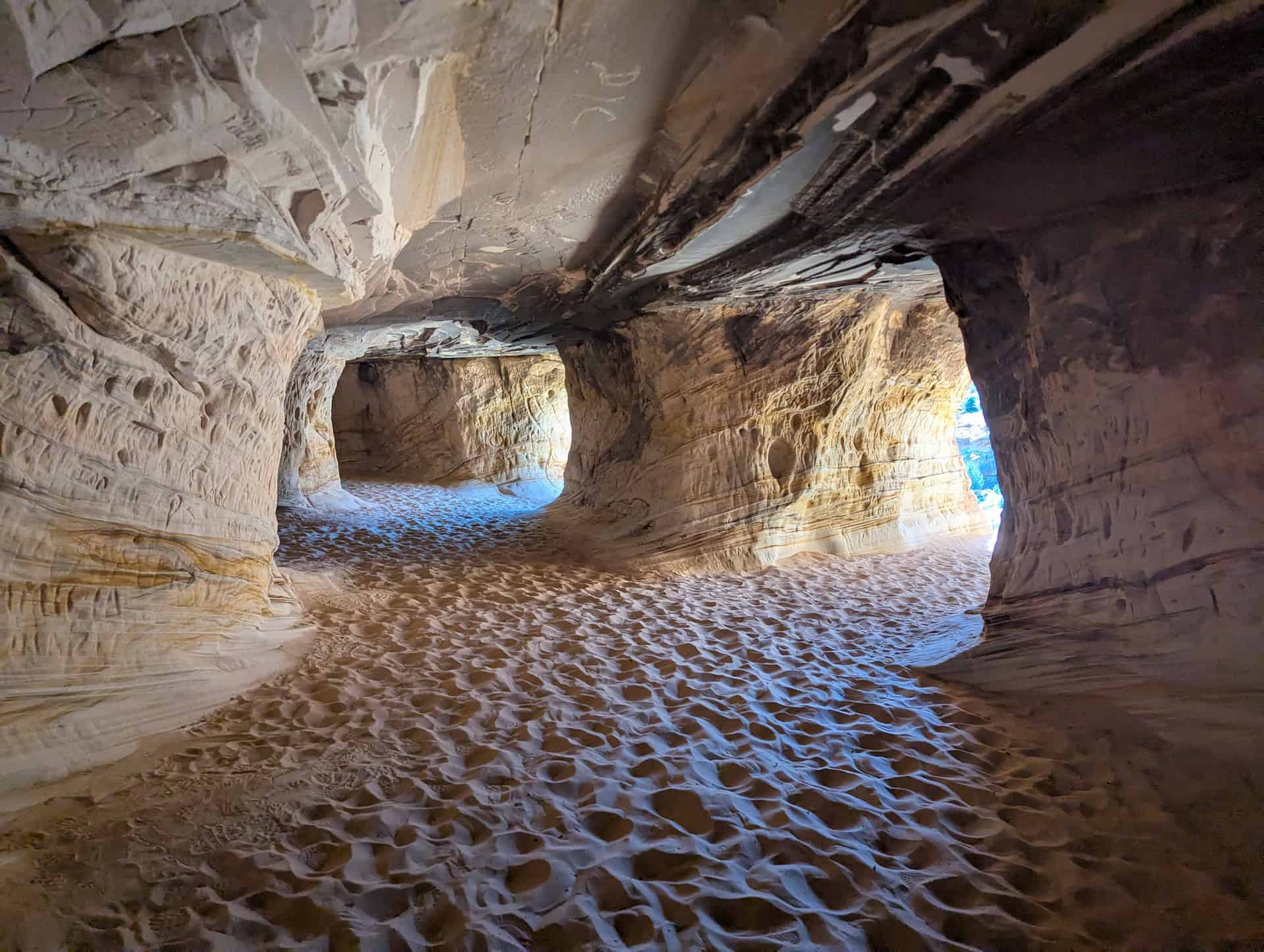
After exploring the caves, return the same way, retracing the traverse, the slickrock descent, and the braided trails through the wash back to the parking area.
Moqui Sand Caves – Additional Details and Hiking Tips
Canine companions: Dogs are allowed on the Moqui Sand Caves Trail, but they must remain on a leash. Be aware that the slickrock ascent can be challenging for some dogs, especially on hot days when the sandstone heats up.
Trail environment: The trail follows sandy paths and a shallow wash at first, then transitions to firm sandstone as you approach the cliff. Shade is extremely limited until you reach the caves themselves, which offer a cool, sheltered interior. Expect typical high-desert vegetation, open views toward the red cliffs north of Kanab, and the highway visible below.
Route signage: Signage is minimal but adequate: a small trail marker at the parking area and a well-defined network of braided social trails that all generally lead in the right direction. Because much of the route crosses open slickrock or meanders through washes, a downloaded offline map can be useful, though navigation is straightforward.
Trail surface / Technical aspects: The trail is easy and mostly flat until the ascent up the steep slockrock, which is aided by a fixed rope. This is not considered technical climbing, but hikers should be sure-footed and comfortable with a bit of exposure. The traverse along the sandstone ledge to the cave entrances requires careful footing, especially for those with height sensitivities.
Slope and effort: Most of the route has almost no elevation change until the slickrock ramp. Although it looks intimidating, the rock grip is excellent, and the slope becomes gentler the farther north you continue before ascending. The hike remains short and manageable for most visitors, including families with older children.
Previous Hiking Experience: No significant experience is required, but beginners should be prepared for the short slickrock climb and the mildly exposed ledge near the cave openings. Good footwear makes a meaningful difference here—avoid sandals if possible due to loose sand and angled rock.
Cell Service: Cell reception is generally strong because the trail sits close to Highway 89. However, the signal may weaken inside the cave chambers. Offline maps are still recommended if you’re exploring additional Kanab area trails.
Leave No Trace: Stay on established paths when possible and avoid creating new social trails. Inside the caves, resist the temptation to carve or write on the sandstone—unfortunately, existing graffiti is already extensive. Pack out everything you bring, and step aside politely in crowded areas; this trail is extremely popular for photos.
Bugs: Insects are minimal. You may encounter a few gnats or flies in warm weather, especially after rainfall. Mosquitoes and ticks are uncommon, and repellent is rarely necessary.
Equipment: No technical gear is needed. Wear sturdy shoes or trail runners with good traction for the steep slickrock section. Bring plenty of water, sun protection, and avoid hiking the slickrock barefoot or in thin-soled sandals. Trekking poles are usually not needed, but can help those who prefer extra stability on the ascent.
Weather and Exposure: This short trail is fully exposed to the sun and heat until you reach the cave entrances. Summer temperatures in Kanab routinely exceed 90–100°F (32–38°C). Mornings and late afternoons offer the most comfortable conditions, and the cave interiors provide welcome shade.
Wildlife: Expect to see lizards, small birds, and occasionally chipmunks near the cave entrances. Rattlesnakes are possible in the area, especially near rock crevices and shaded ledges. Watch your step, but don’t panic; encounters are very uncommon.
Current Trail Conditions: Because this is not a state or national park–managed trail, there is no official conditions page. Check resources such as AllTrails or recent Google Maps reviews for updates on accessibility and seasonal considerations.
Best Time to Hike the Trail
Because the Moqui Sand Caves Trail is short, close to the highway, and mostly exposed slickrock, it’s best enjoyed during cooler parts of the day and in the milder seasons. Unlike some nearby trails, it remains open year-round, but conditions can change how comfortable—and safe—the hike feels.
Spring (March–mid May):
Spring is one of the ideal seasons for this short hike. Daytime highs typically range from 60–80°F (15–27°C), making the approach across open slickrock comfortable. Wildflowers may bloom in the nearby desert valleys, and lighting conditions are excellent for photography. Afternoon winds are common, especially along the exposed upper ledges.
Fall (October–early November):
Fall offers similarly pleasant temperatures, usually 65–80°F (18–27°C) under softer golden light. This is one of the most popular times to visit Kanab and the surrounding parks, so expect more hikers near the cave entrances, particularly around sunset when the interior glows warmly.
Winter (December–February):
Winters are generally mild in Kanab, with daytime highs typically 40–55°F (4–13°C). The trail remains accessible, though mornings can feel quite cold, and shaded areas near the cliff base may hold frost. Crowds thin out dramatically, making this a great time for a quieter visit. A rare dusting of snow can make the slickrock slippery—use caution on the final slope.
Summer (June–August)
Summer brings the most challenging conditions. Afternoon highs frequently climb above 95–105°F (35–40°C), and the slickrock radiates heat. If hiking in summer, start early in the morning or near sunset and bring extra water. Inside the caves, temperatures are significantly cooler, offering welcome relief.
Quick Summary – When to Visit
Spring and fall offer the most comfortable temperatures and best lighting for photography.
Winter is quiet and cool, with minimal crowds.
Summer is extremely hot—go early or late if you visit during this season.
Hiking Packing List
All Trails subscription – This comes in really handy for areas with little or no cell reception, as the annual subscription allows you to download trail maps for offline use.
External Battery – If you are using your phone to track your progress along the trail or to help with navigation, you certainly don’t want your phone to die on you. That’s especially true in the unlikely event that you might get hurt or need assistance.
Hiking poles – These can be particularly useful in steep trails or muddy/boggy trail conditions.
Water Filter Bottle – The Life Straw bottle is an advanced water bottle with a filter that not only improves water taste but more importantly filters out bacteria and parasites, chemicals and microplastics.
Headlamp – very practical and a smart choice if you plan to start your hike before sunrise or finish it after sunset.
A Short History of The Moqui Sand Caves
The Moqui Sand Caves are often mistaken for ancient Native American dwellings, but they’re actually man-made caverns carved into a Navajo sandstone cliff in the 1970s. These caves were created during a short-lived silica sand mining operation, where soft Navajo sandstone was quarried and processed for use in glass production. The project didn’t last long, but the hollowed chambers remained—and over time, their sculpted curves, carved “windows,” and smooth interior walls turned them into a quirky roadside attraction just north of Kanab.
The name “Moqui Sand Caves” adds to the confusion. It evokes the idea of ancestral Puebloan (Anasazi) or Hopi history, yet the caves themselves have no Indigenous origin. This misconception is especially common because of the Moqui Cave museum located just down the highway. Unlike the sand caves, the Moqui Cave museum does incorporate Native American artifacts and historical exhibits, but it’s a privately built mid-20th-century attraction rather than an archaeological site. The two places share the same sandstone cliff band and a similar name, which has blurred the distinction for many visitors.
Near the trail, hikers may also notice historic signatures and markings, many dating back to early 20th-century settlers, ranchers, and travellers who passed through the area long before US-89 existed.
Other Nearby Sites and Attractions
Moqui Cave (Museum) – Just a couple of minutes north of the trailhead, Moqui Cave is a roadside museum housed inside a sandstone cavern. Inside, you’ll find fluorescent minerals, dinosaur tracks, Southwestern artifacts, and a quirky mix of local history displays. It’s a quick stop and pairs naturally with a visit to the Sand Caves.
Belly of the Dragon – A short drive east of Kanab, this man-made tunnel carved beneath Highway 89 offers a fun, family-friendly walk through sculpted orangey sandstone. The hike is brief but photogenic, especially when soft light filters through the rippled walls. The road to the trailhead is usually passable for most vehicles.
Coral Pink Sand Dunes State Park – Located about 30 minutes west of Kanab (20 minutes from the Moqui Sand Caves), this state park features sweeping dunes of uniquely coral-colored sand. Popular for hiking, photography, and ATV adventures, the dunes shift constantly with the wind, creating dramatic patterns and ridges.
If you want to skip the logistics and enjoy a ready-made experience, you can book a 2-hour Highlights Package with ROAM Adventure Center at Coral Pink Sand Dunes. It includes a one-hour UTV ride across the dunes, 30 minutes of sandboarding, and a 30-minute guided walk—an easy, all-in-one way to experience the park’s best features without planning each activity yourself:
Zion National Park – Less than an hour away, Zion is one of Utah’s most iconic national parks—famous for its sheer canyon walls, lush riverbanks, and bucket-list hikes like Angels Landing and The Narrows. If you’re using Kanab as a base, Zion makes for an easy and spectacular day trip.
Best Friends Animal Sanctuary – North of Kanab in the beautiful red-rock canyons (a 5-minute drive from the Moqui Sand Caves), this world-renowned animal sanctuary offers guided tours, scenic drives through its expansive property, and opportunities to interact with rescued animals. It’s a peaceful and inspiring place that many visitors consider a Kanab highlight
Peekaboo Slot Canyon (via 4 x 4 road) – This gorgeous, Navajo Sandstone slot canyon requires navigating a deep-sand road that typically demands a high-clearance 4×4. Guided tours are common and recommended for most visitors. The slot itself is beautiful—similar to Antelope Canyon but far less crowded.
If you don’t have a 4×4 vehicle, you can join a UTV guided tour to reach the canyon:
Once Upon A Time In America Museum – A unique film-history stop celebrating Hollywood’s Western era, the museum showcases props, memorabilia, and stories from classic movies shot in the Kanab region. It’s a fun way to connect Kanab’s landscape to its cinematic past.
Red Pueblo Museum and Heritage Park – Located in nearby Fredonia, this small museum features Ancestral Puebloan artifacts, reconstructed dwellings, and outdoor exhibits that offer context for the region’s Indigenous history. It’s a low-key but meaningful stop for archaeology enthusiasts.
Moqui Sand Caves Trail – Frequently Asked Questions
How long does the hike take?
Most visitors complete the out-and-back walk in 30–60 minutes, depending on how long they spend exploring the cave interiors and taking photos.
Is the hike difficult?
Overall, the trail is easy to moderate. The approach through the wash is flat and straightforward, but reaching the caves requires a short, steep scramble up slickrock, sometimes assisted by a fixed rope. Good traction shoes are recommended.
Is the trail safe for kids?
Yes, but with supervision. Families regularly hike to the caves, but the final climb and the ledge traverse to the cave entrances have exposed sections. Confident young hikers usually manage fine, but those with a fear of heights may find the final section intimidating.
Can dogs hike the Sand Caves Trail?
Yes. Dogs are allowed, but they must be kept on leash. Be aware that slickrock can be hot in summer and may be rough on sensitive paws.
Are drones allowed?
There is no posted ban, but the trail is extremely popular and narrow in sections. Out of courtesy and safety, drones are not recommended, and some tour operators discourage their use.
Can I go inside the caves?
Absolutely. Visitors are free to walk through the caverns, explore the carved “windows,” and enjoy the views, but please do not carve or write on the walls, as graffiti has become a growing issue.
Explore More Utah Roadtrip Guides
Continue exploring Utah with these detailed guides:
Best Stops and Attractions Between Vegas and Zion
Zion National Park Guide
Bryce Canyon National Park Guide
Photography Gear
If you like our photography, you might be interested in some of the gear we use to shoot our travel and hiking destinations.
Camera Body – Nikon Z 6ii Fx-series Mirrorless Body
Main Lens – NIKON 24-120mm F/4G ED VR AF-S
Zoom Lens – Sigma 745-306 150-600mm f/5-6.3
Polarizing filters – Urth Circular Polarizing (CPL)
Camera Tripod – K&F Concept 64-inch Camera Tripod
Mini-tripod – Lammcou Flexible Camera Tripod
Camera/hiking backpack – Vanguard Alta Rise 48 Backpack
Universal Travel Adapter – VYLEE Universal International Power Travel Plug
Other Travel Essentials
Travel Insurance
SafetyWing is a travel insurance company that offers comprehensive coverage for travellers. Includes Medical Insurance and Travel Insurance. Primarily geared towards long-term travellers, digital nomads, and expats.
e-Sim cards
Airalo is the world’s first and largest eSIM store with eSIM plans for 200+ countries and regions worldwide. With Airalo eSIMs, travellers can get connected the moment they land at their destination and avoid nasty data roaming charges
eSIMS are a sustainable alternative to single-use SIM cards – they are 100% digital, require less energy to produce and be re-used rather than disposed of.
Car Rentals
Discover Cars is our go-to website for car rentals. We almost always find our preferred rate there.
Transfer from Airport
Welcome Pickups is our favourite private transfer service, which you can pre-book at a fixed price. Currently available in 220 cities all over the world (mostly in Europe, but with several major cities in Asia, the Middle East and the US).
Kiwitaxi is another private transfer service – we haven’t tried it yet, but it’s currently available in a few more countries (102 as of 2024).
Hotels and Accommodations (coming soon)
Photography Prints
If you found this blog useful, you can help support our blog by purchasing low-cost digital prints. Printed physical prints are also available for purchase.


—–
Well, that wraps it up! We hope you enjoyed our Kanab Hiking Guide for the Moqui Sand Caves Trail and that it will prove useful for planning your hiking trip.
—–
You might also be interested in these related pages: