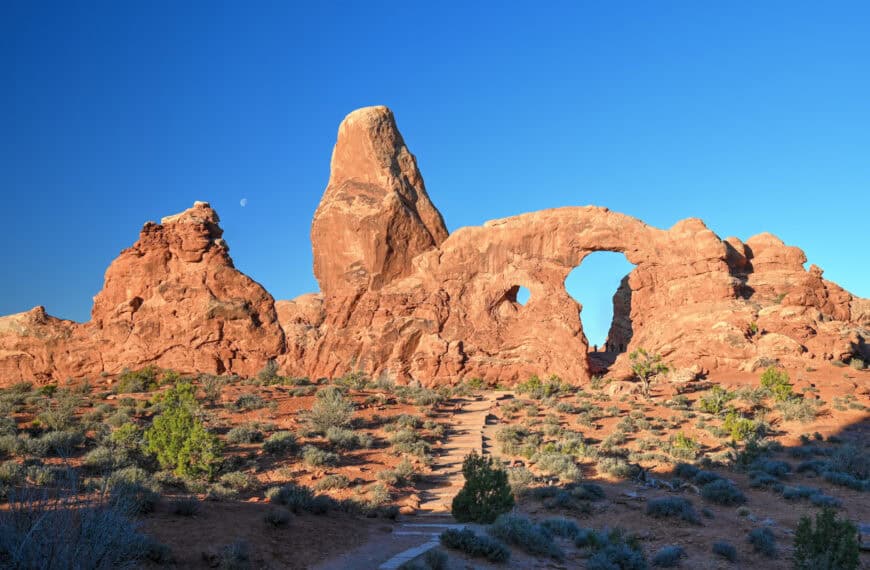
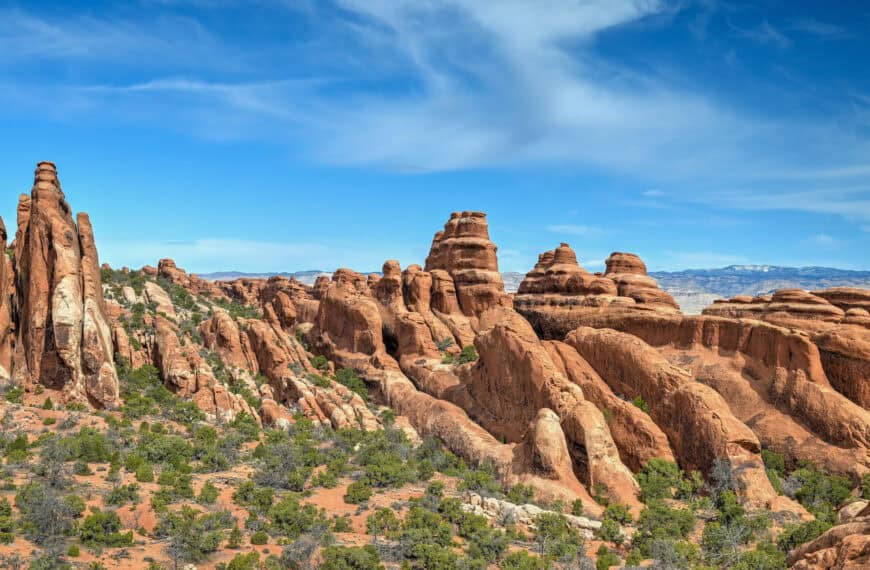
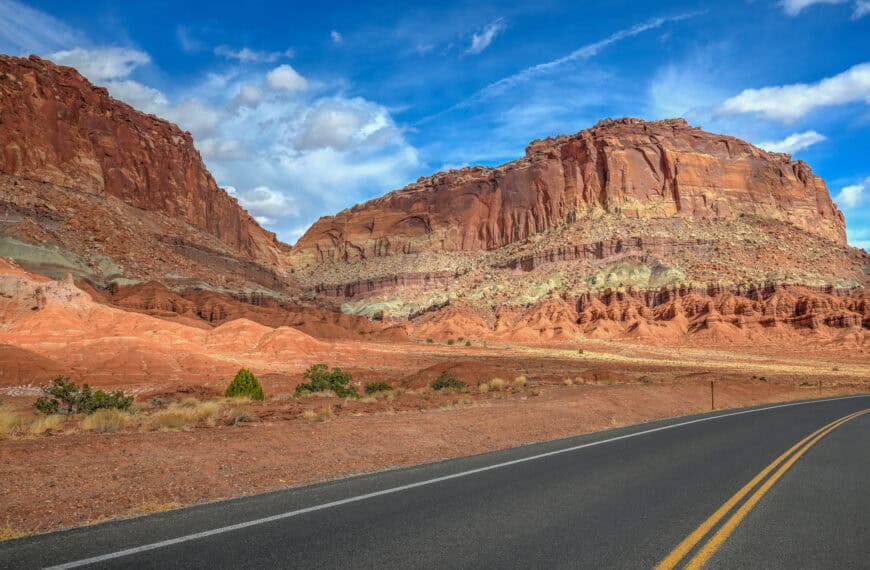
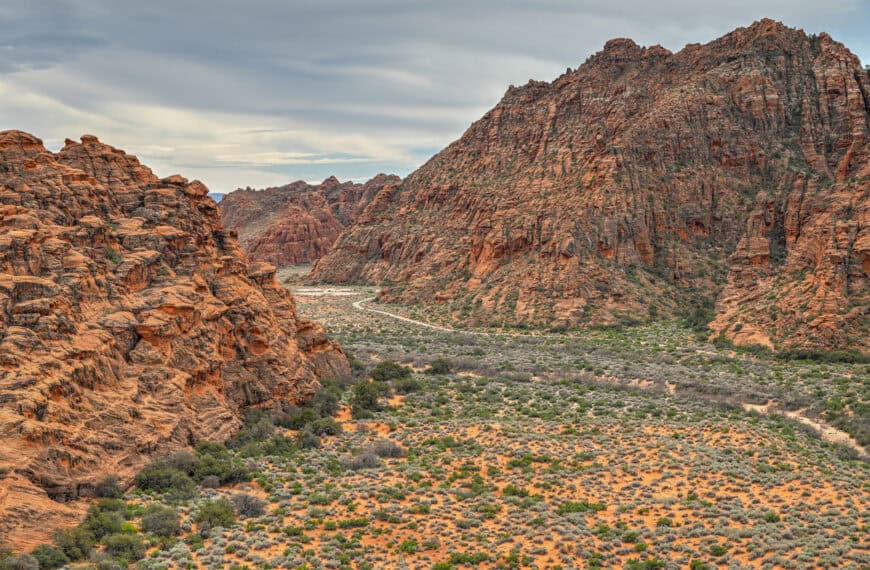
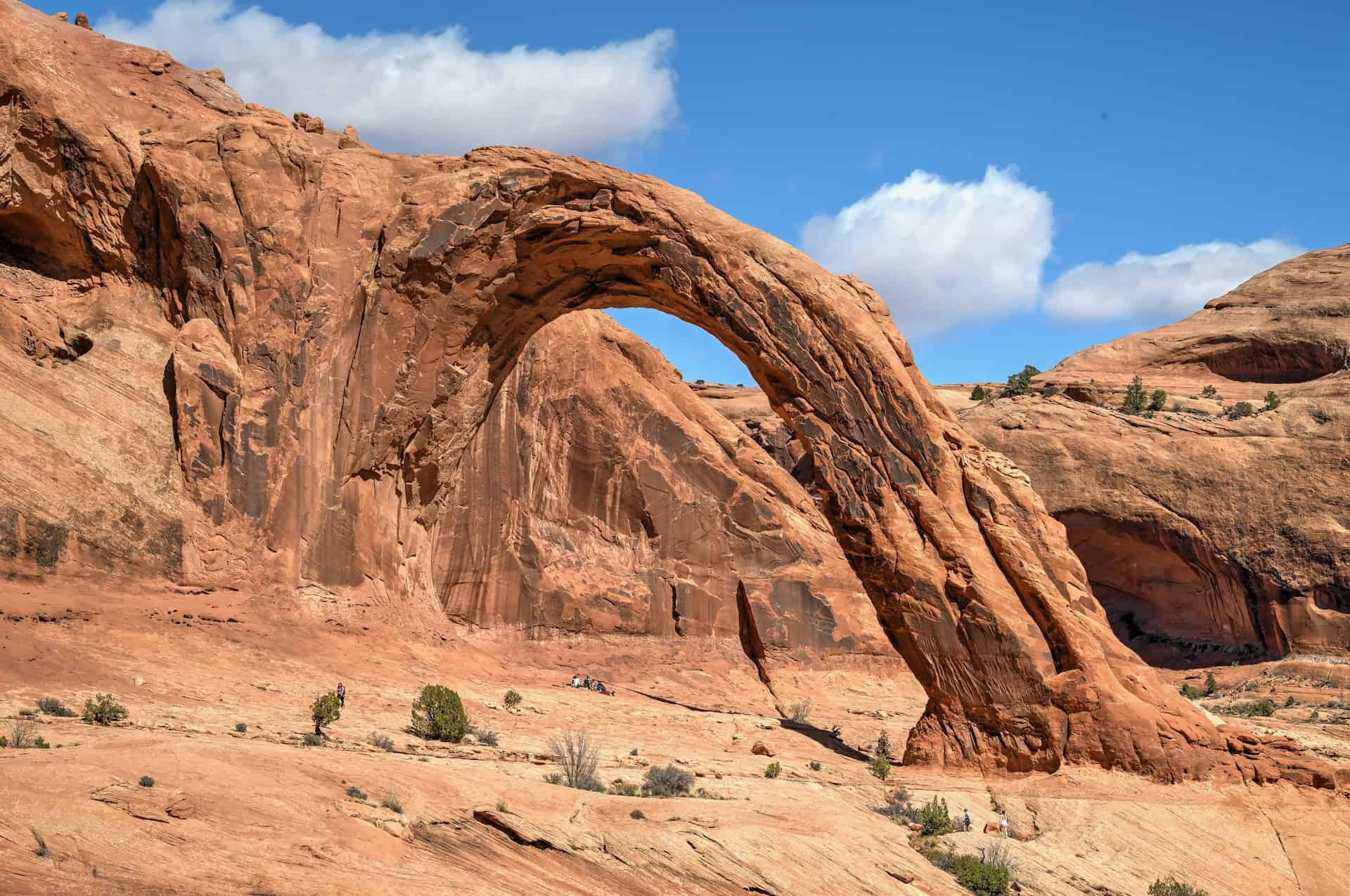
The Corona Arch Trail is one of the most popular hikes near Moab, and one of the best ways to see a massive sandstone arch without entering one of Utah‘s national parks. Located on BLM land along the Colorado River, this hike leads to Corona Arch, a large freestanding arch that rivals some of the formations found in Arches National Park. Along the way, the trail also passes Pinto Arch, a smaller but worthwhile detour that branches off the main route.
In this guide, we’ll cover everything you need to know about hiking to Corona Arch and Pinto Arch, including trail details, what to expect along the route, how the two arches compare, and practical tips for planning your visit.
Corona Arch & Pinto Arch Trail – At a Glance
One of the best arches outside the National Parks – Corona Arch is massive and easily rivals many arches in Arches National Park.
Shared trail with a worthwhile detour – Pinto Arch branches off the main route and adds a short extension to the hike.
Scenic desert setting along the Colorado River – The trail runs through open terrain with views of cliffs, mesas, and the river corridor.
Hike with some unique features – Includes a short ladder climb and a cable-assisted section across slickrock. These are not technically difficult, but they do add some interesting variety to the route.
Trail Difficulty: Moderate
Time Required: 1h30-2h (including detour to Pinto Arch)


Disclosure: This page (Corona Arch and Pinto Arch Trail Guide) may contain product affiliate links. At no additional cost to you, we may receive a commission for purchases made through these links. More details can be found on our disclosure and policies page.
Corona Arch and Pinto Arch Trail: Location, Map, and How to Get There
The Corona Arch and Pinto Arch Trail is located just outside Moab, along the Colorado River on BLM (Bureau of Land Management) land.
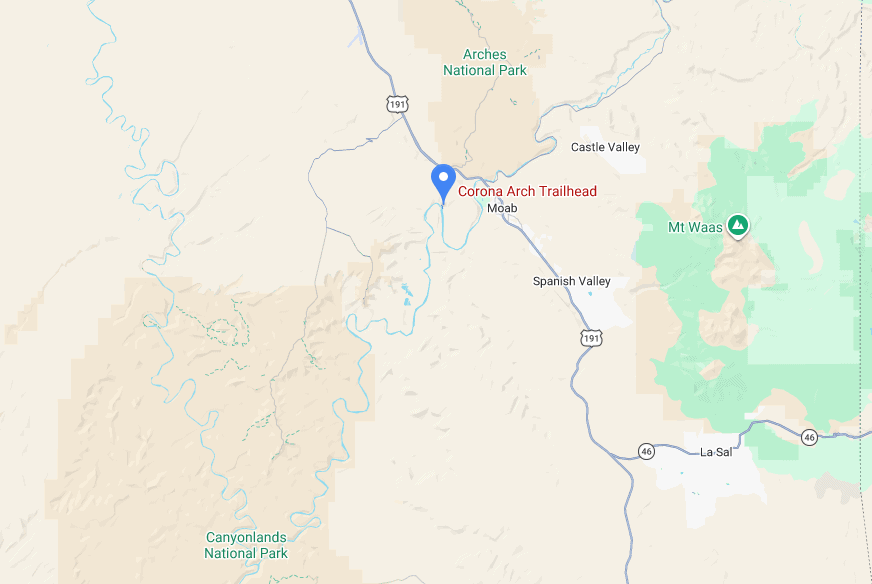
Driving Times to Moab
- Capitol Reef National Park: 2 hours 30 minutes
- Monument Valley: 2 hours 20 minutes
- Salt Lake City: 3 hours 45 minutes
- Bryce Canyon National Park: 4 hours 30 minutes
- Las Vegas: 6 hours 30 minutes
These times assume clear weather and normal traffic conditions.
If you need to book a rental vehicle for your hiking excursion, we highly recommend using Discover Cars to get the best rates on your rental in Utah, Nevada, and Arizona.
We also highly recommend Airalo (eSIM card) for your connectivity needs when travelling abroad. Airalo is the world’s first and largest eSIM store with eSIM plans for 200+ countries and regions worldwide.
Corona Arch and Pinto Arch Trail – Trailhead Access, Parking & Fees
Trailhead Location
From Moab, head north on US-191, then turn left onto Potash Road (UT-279). Follow this scenic road along the Colorado River for about 10–15 minutes until you reach the signed Corona Arch trailhead. (link to Google Maps).
The route begins in a flat, open area near the parking lot, with the trail crossing desert terrain toward the distant cliffs.
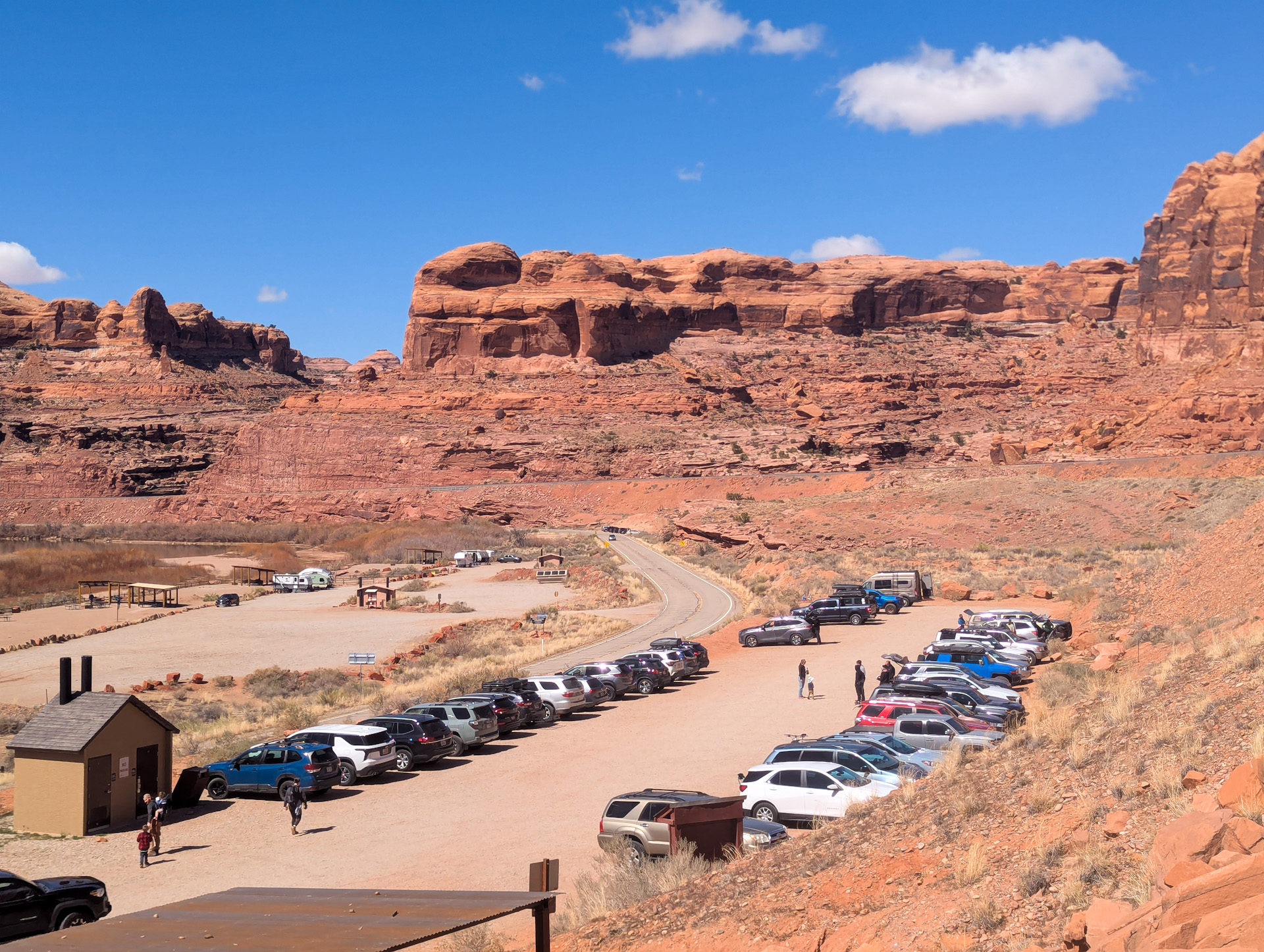
Trailhead parking lot
There is a medium-sized dirt parking area located directly beside the trailhead.
The lot can fill up during peak hours, especially in spring and fall, as this is one of the most popular hikes outside the national parks. Mid-morning through early afternoon tends to be the busiest period.
Facilities
Vault toilets are available at the trailhead parking area.
Trail Opening Hours
The trail is accessible year-round, 24 hours a day, weather permitting.
Entrance Fees for Arches National Park
None. The trail is located on BLM land, and no entrance fee is required.
Corona Arch and Pinto Arch Trail – Trail Stats, Difficulty, and Map
Corona Arch only
Distance: 2.5 miles (4 km)
Route Type: Out & back
Elevation gain: 430 ft / 130 m (cumulative elevation gain)
AllTrails rating (2026): 4.8, 10800 ratings
Duration: Most people complete the full trail in 1h-1h30
Corona Arch + Pinto Arch
Distance: 3.7 miles (6 km)
Route Type: Out & back
Elevation gain: 750 ft / 230 m (cumulative elevation gain)
Duration: Most people complete the full trail in 1h30-2h
Trail difficulty level assessment:
Very Easy | Easy | Moderate | Moderately Challenging | Challenging
Overall, the Corona Arch and Pinto Arch Trail is best described as Moderate. Although the trail isn’t particularly long, the elevation gain is sufficient to take it out of the easy category. Adding the Pinto Arch section to the trail doesn’t add much difficulty, but it does add significant elevation gain, along with the extra distance.
Not an AllTrails member yet? We highly recommend signing up for either their free or paid membership plans. The free plan allows you to find new trails and plan routes but it can only be used while hiking if you have access to mobile data. The paid membership plan (AllTrails+) allows you to download trail maps for offline use and provides live progress updates and off-route notifications.
If you are still uncertain – you should know that the All Trails mobile application was voted the 2023 iPhone App of the Year by Apple.
We find that AllTrails is a great tool to have when hiking, particularly for assisting with navigation when the trail is hard to locate and to help monitor your progress along the trail, which helps estimate how much time you’ll need to complete the trail.
Corona Arch and Pinto Arch – Trail Description and What to Expect
The Common Section (Trailhead to Junction)
The hike begins with a steady climb from the parking area, quickly gaining elevation through a series of short switchbacks and stone steps. Within minutes, the views begin to open up over the Colorado River in the distance.




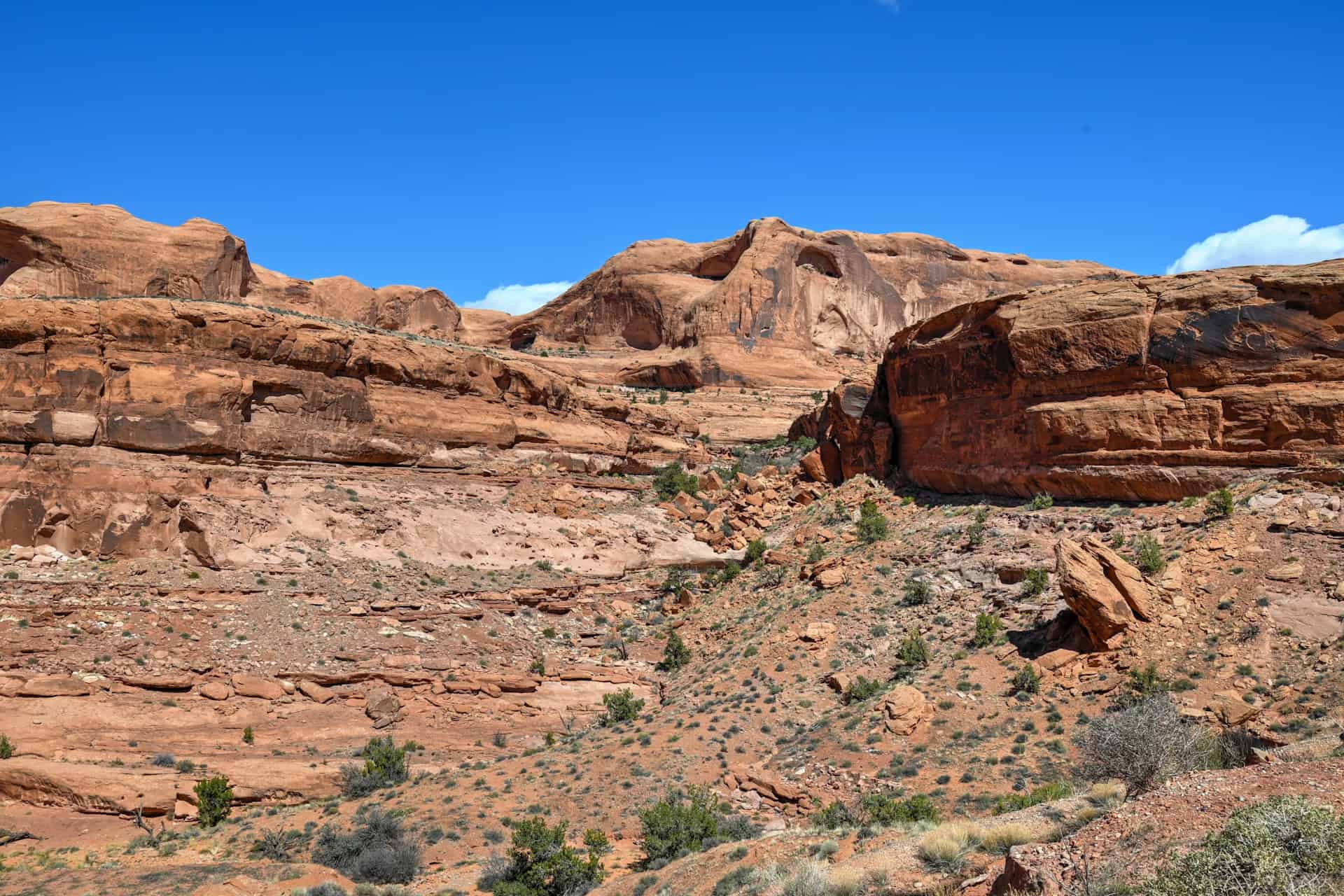

Early in the hike, the trail crosses a set of railroad tracks, one of the more unique features of this route. From there, the path continues across a mix of packed dirt and rocky terrain, with cairns marking the way.


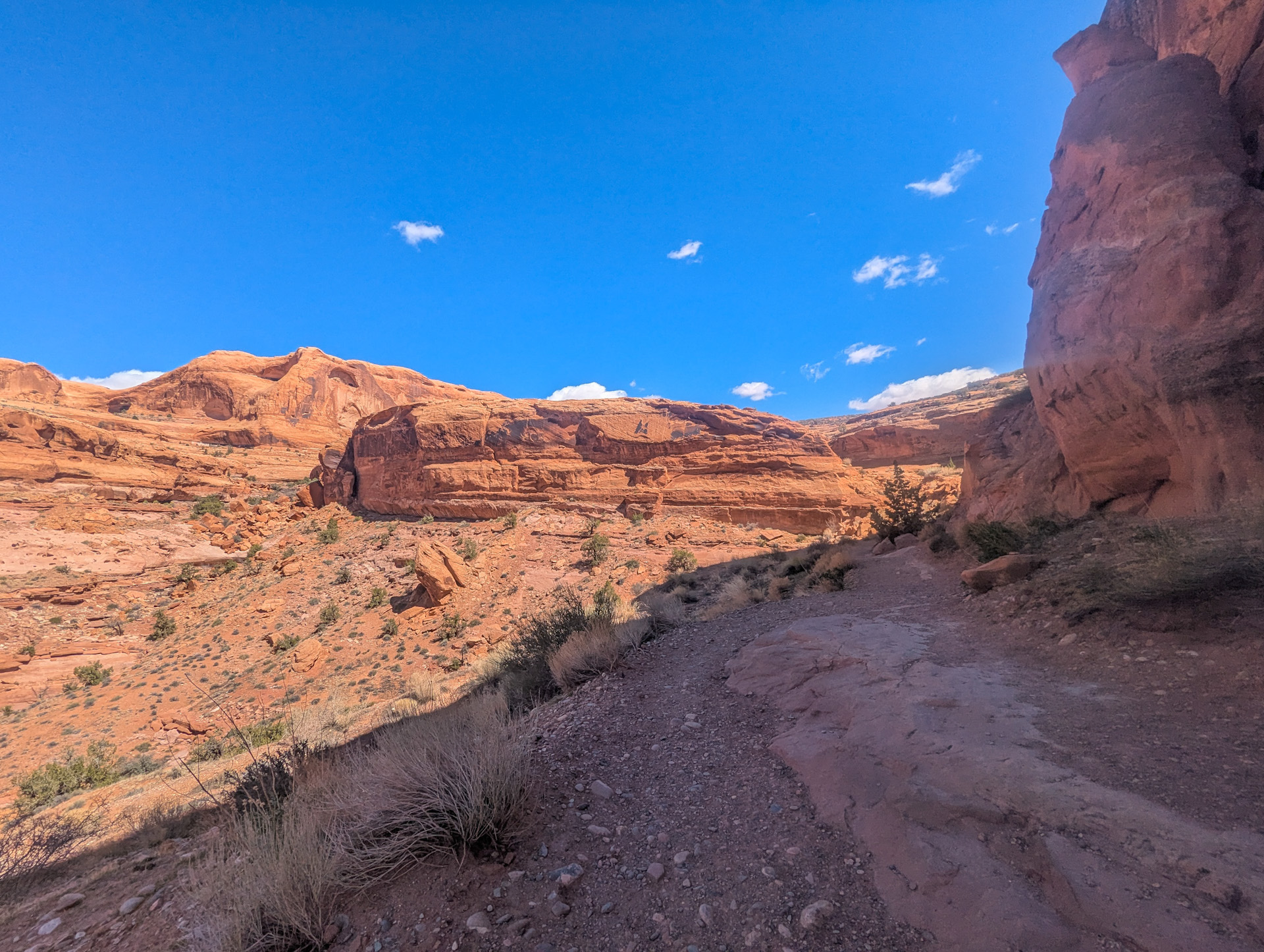
As you move farther from the road, the trail becomes slightly more rugged. The final stretch of this section involves a short, steeper climb over uneven rock that leads up onto a slickrock plateau. While not technical to the point of requiring scrambling, this part does require a bit more attention to footing.


Once on the plateau, the view opens up, and the trail slightly flattens out, offering you the chance to catch your breath a little bit after that steep climb.
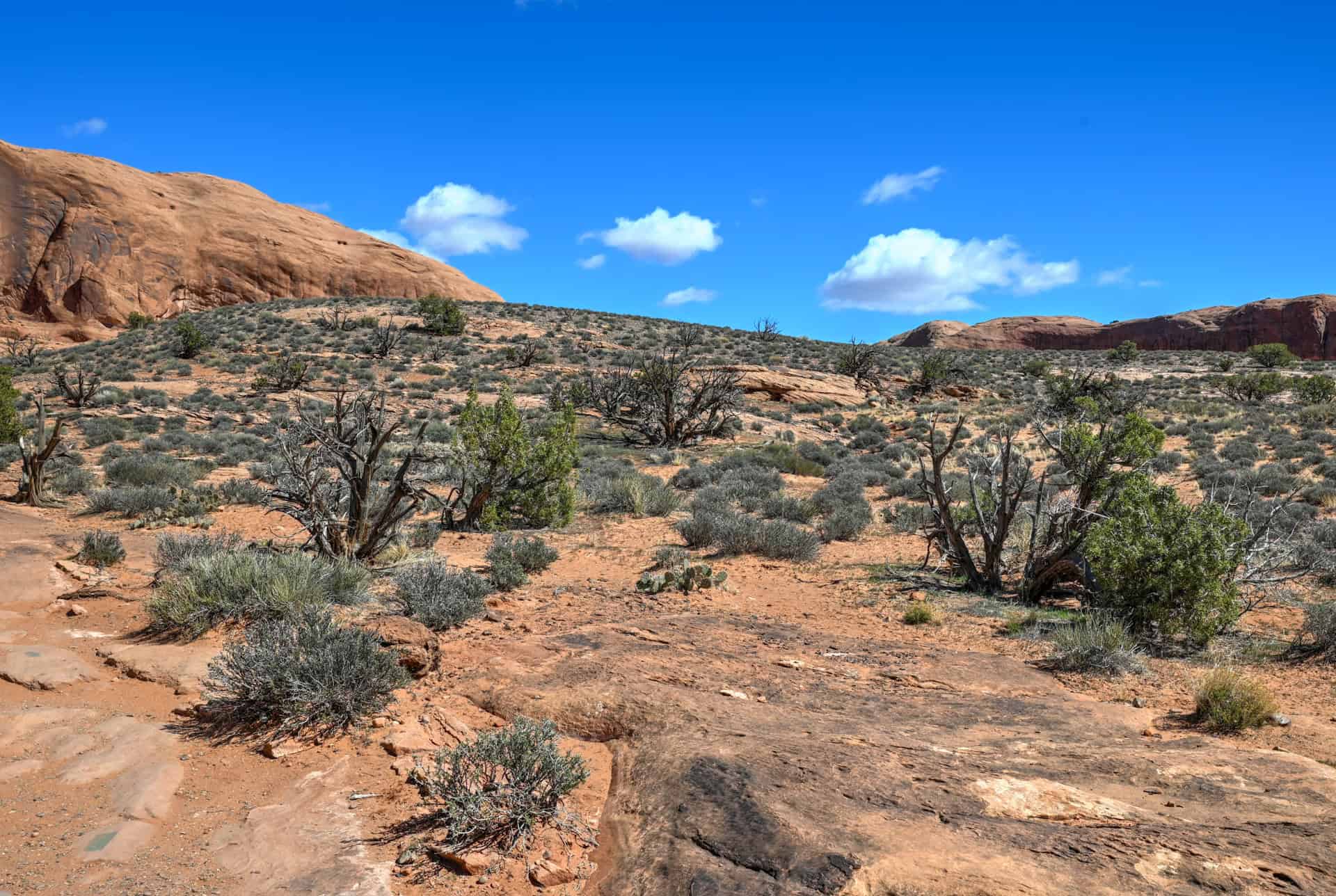
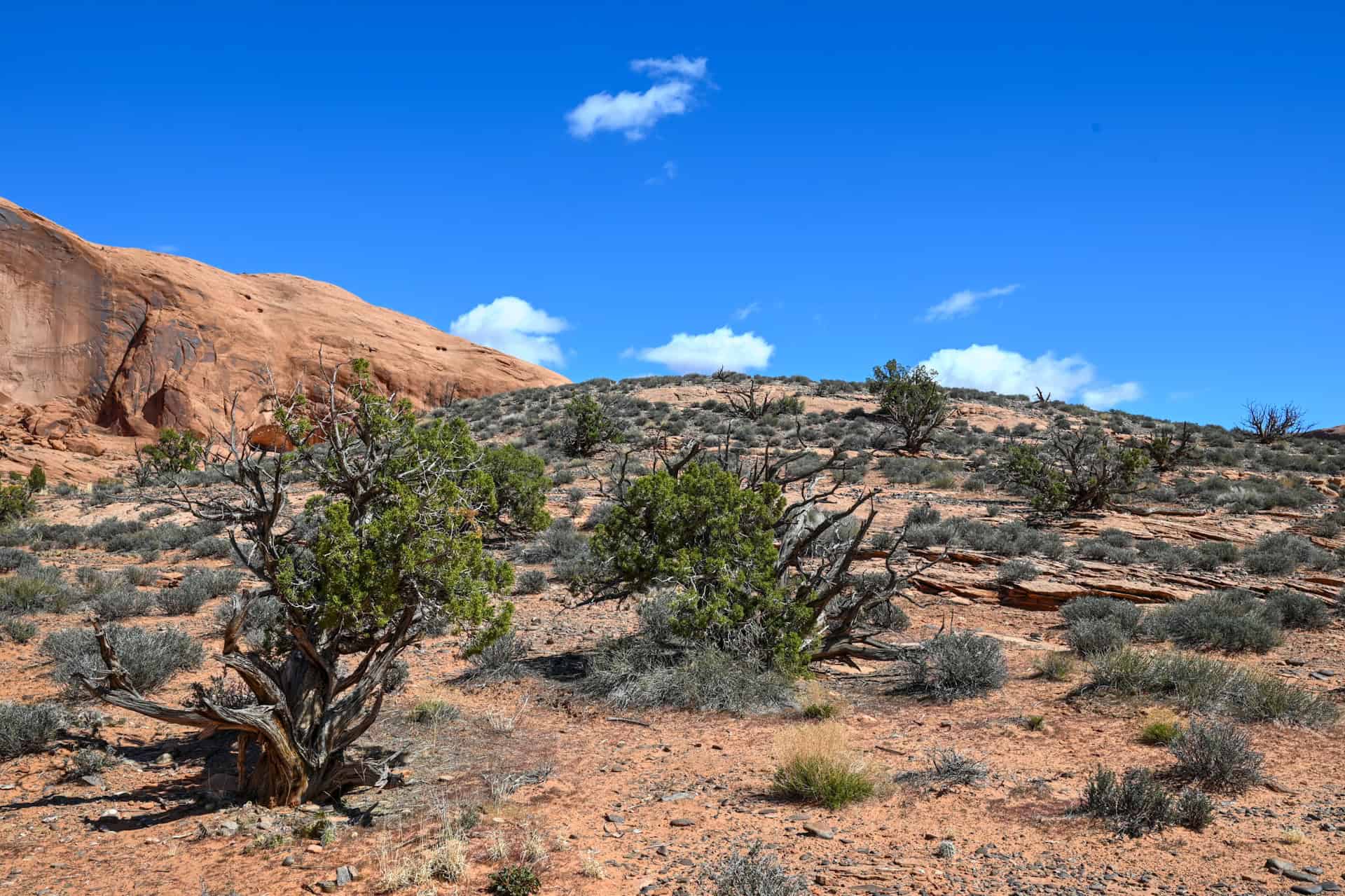
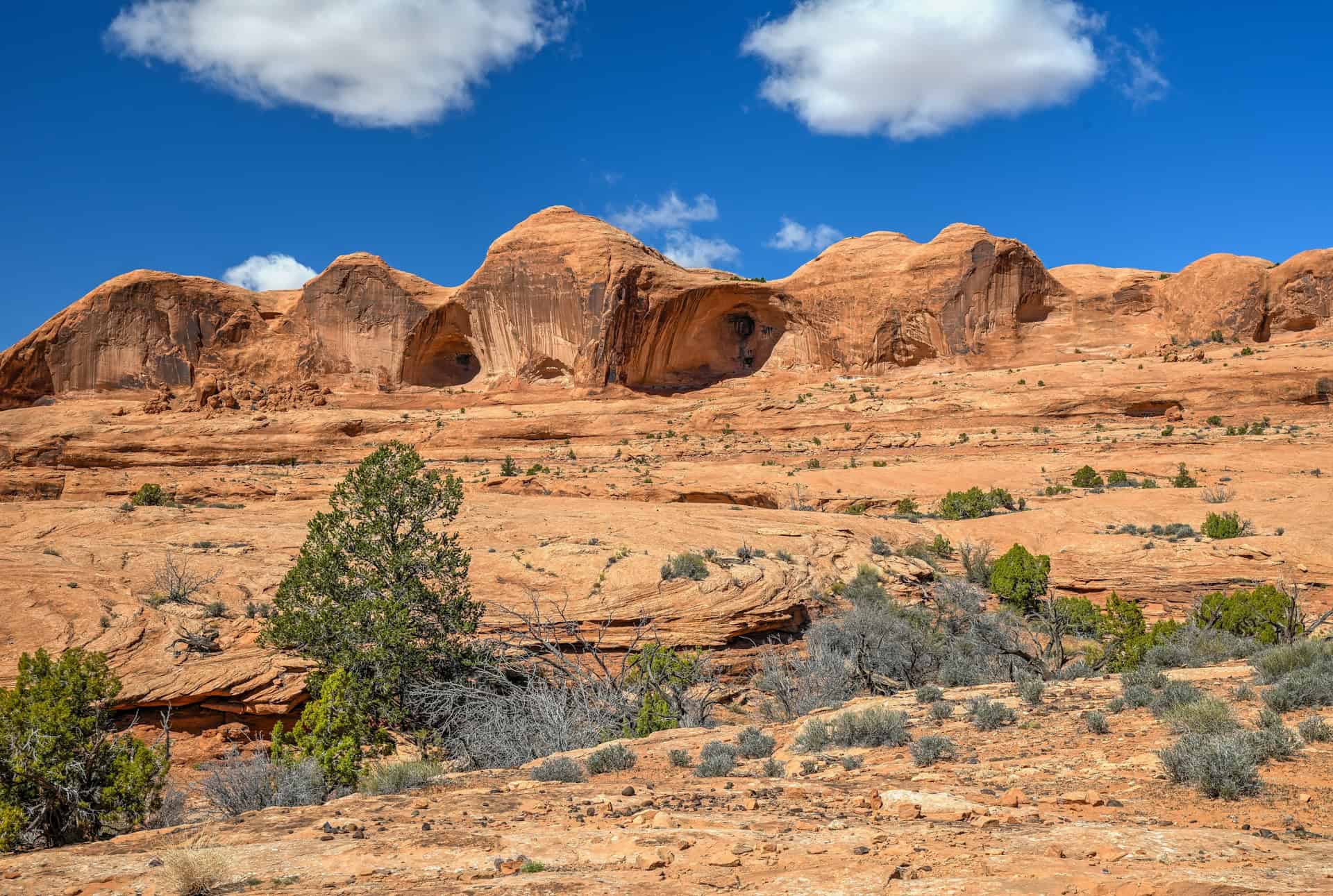
where the trail is marked by painted dashed lines on the slickrock, you’ll soon reach a signed junction where the trail splits: one direction toward Pinto Arch, the other toward Corona Arch.


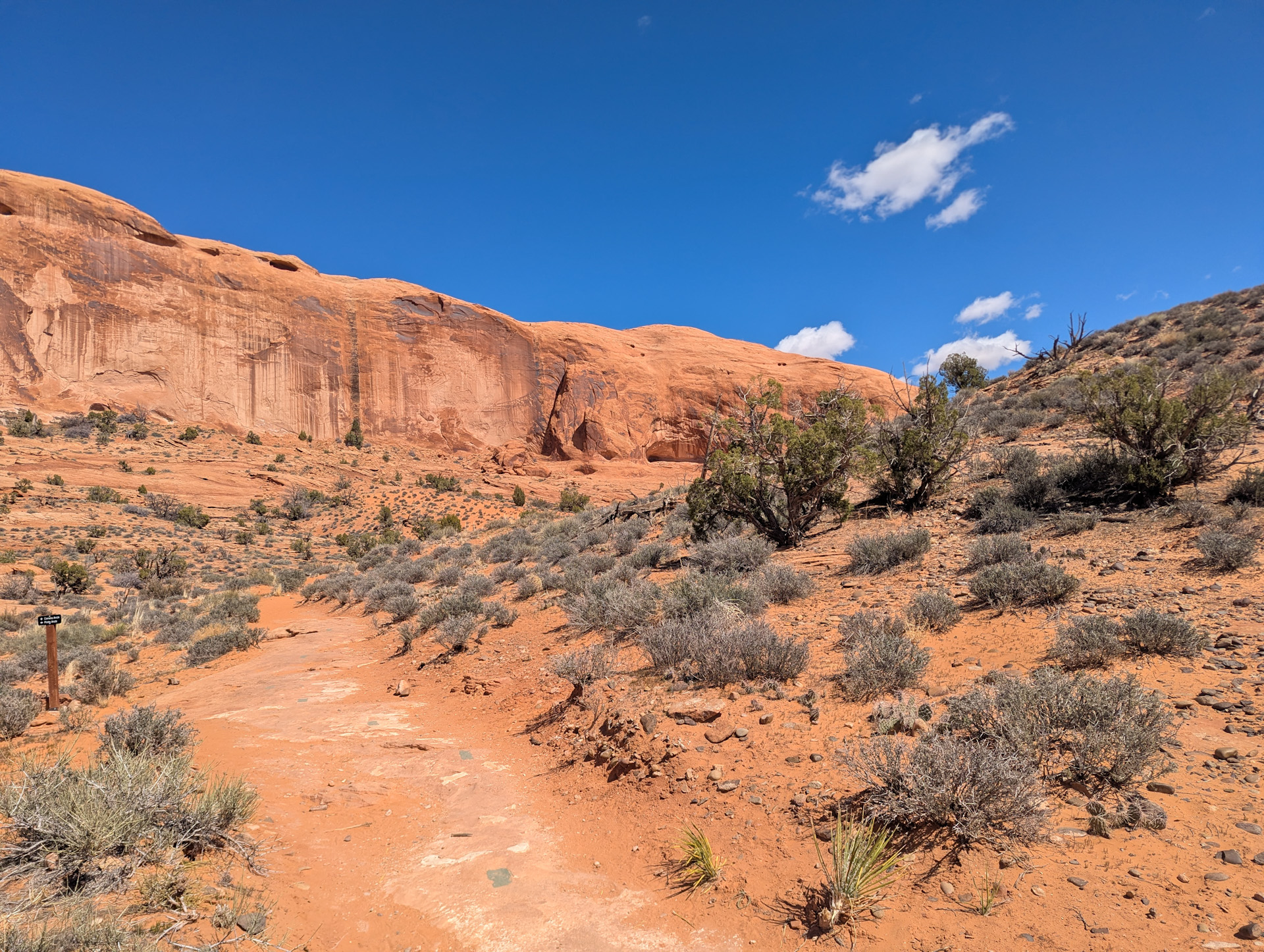


Detour to Pinto Arch
The spur trail to Pinto Arch branches off shortly after reaching the slickrock plateau.
Although relatively short (about 0.6 miles / 1 km one way), this section adds noticeable elevation gain, nearly 300 feet (90 m). The route generally follows a path marked by painted dashes on slickrock, with some steeper sections that require careful footing but no technical climbing.


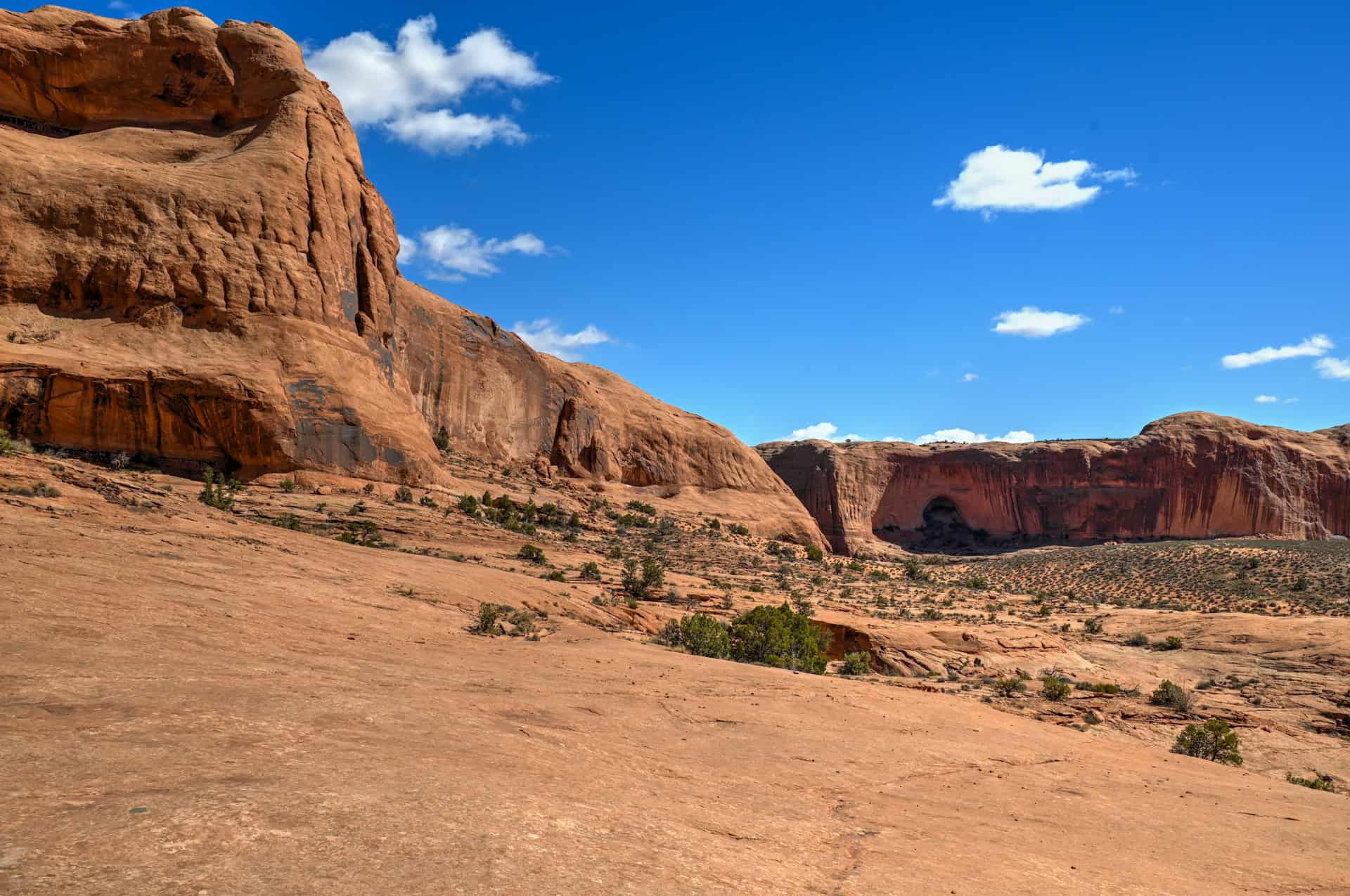
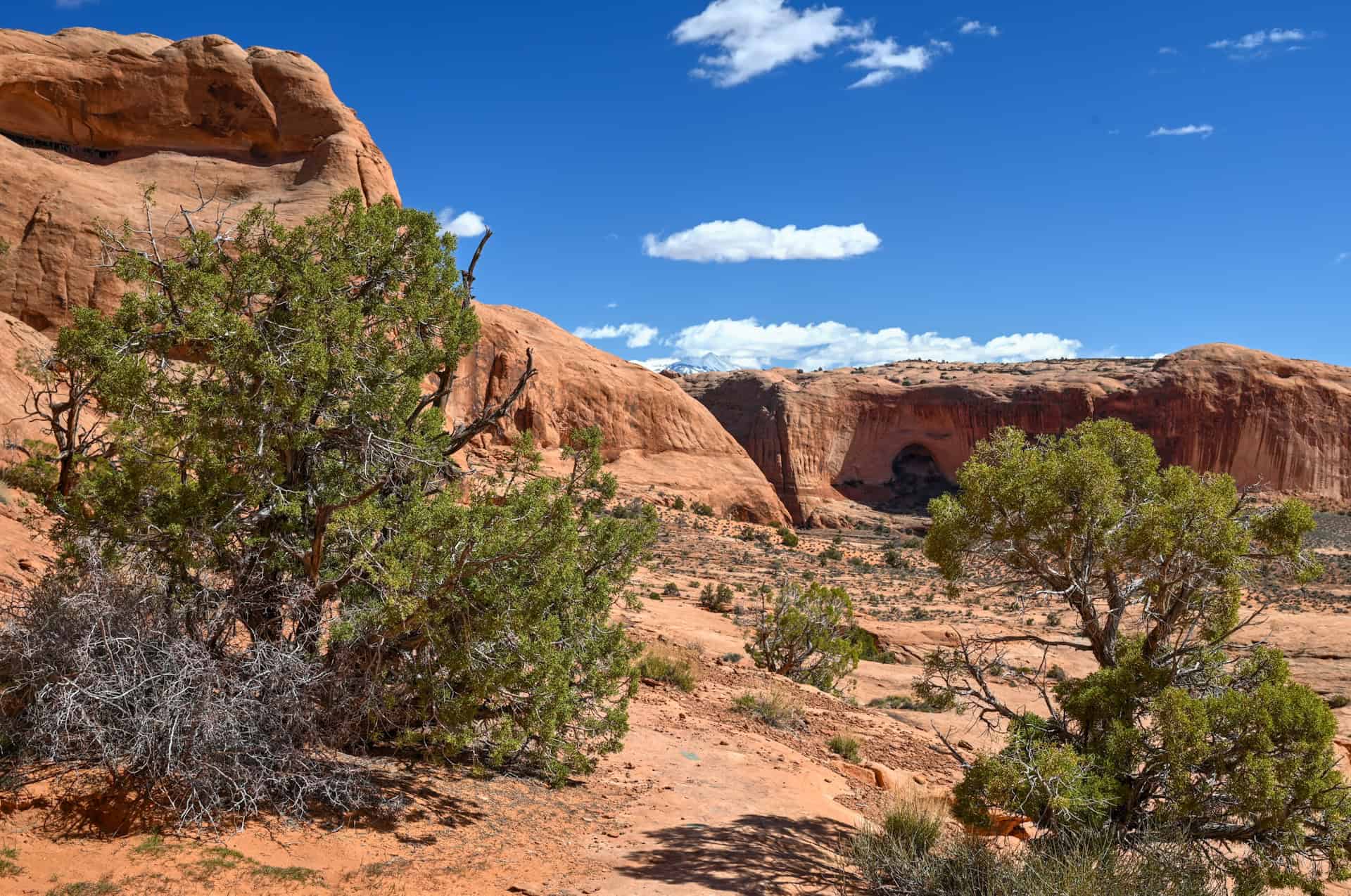
Pinto Arch itself is somewhat understated and doesn’t have the same visual impact as Corona Arch. The reveal is also more gradual, with the arch appearing much smaller in the distance, and with its “rooftop” opening only visible from up close.


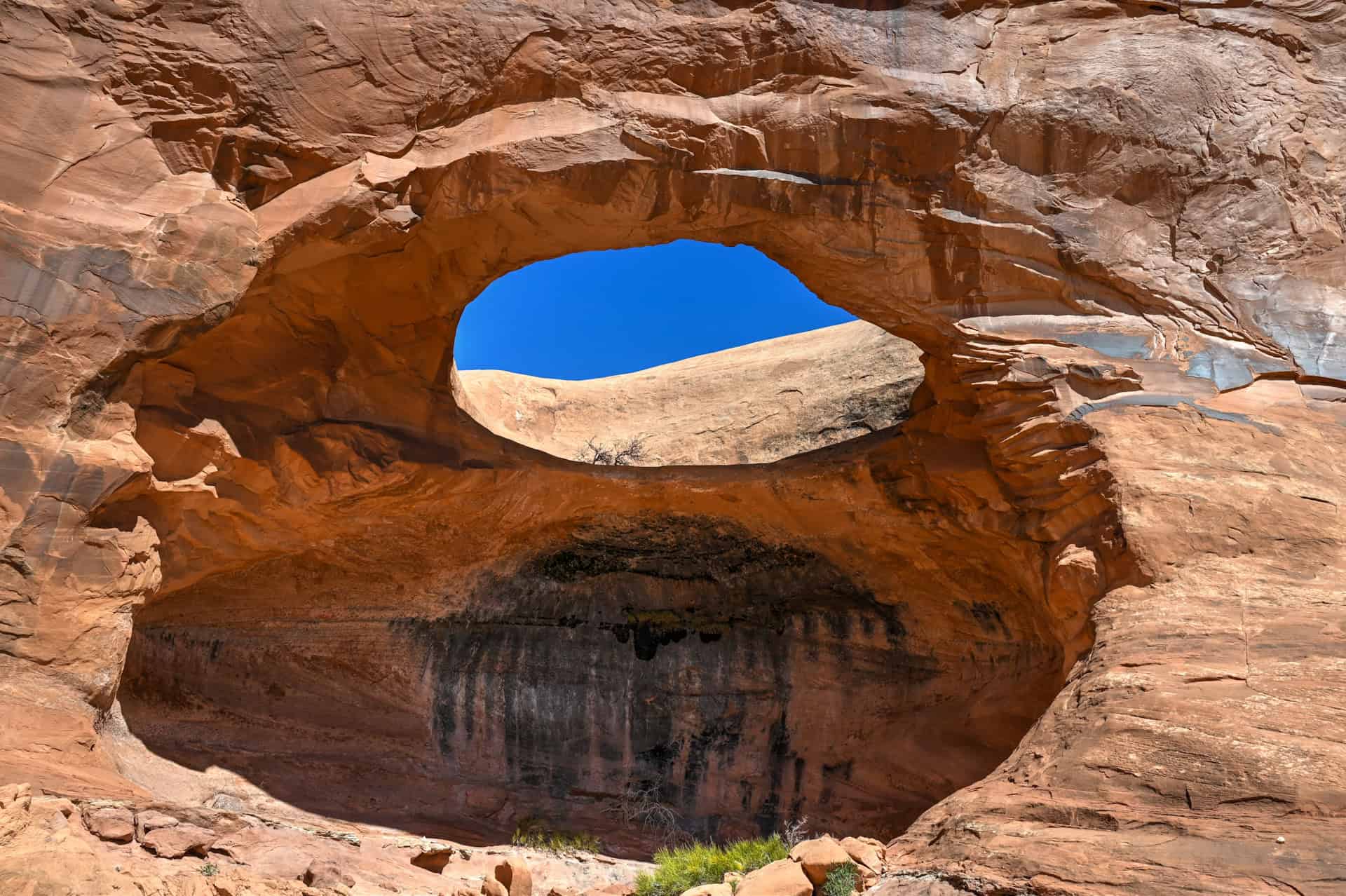
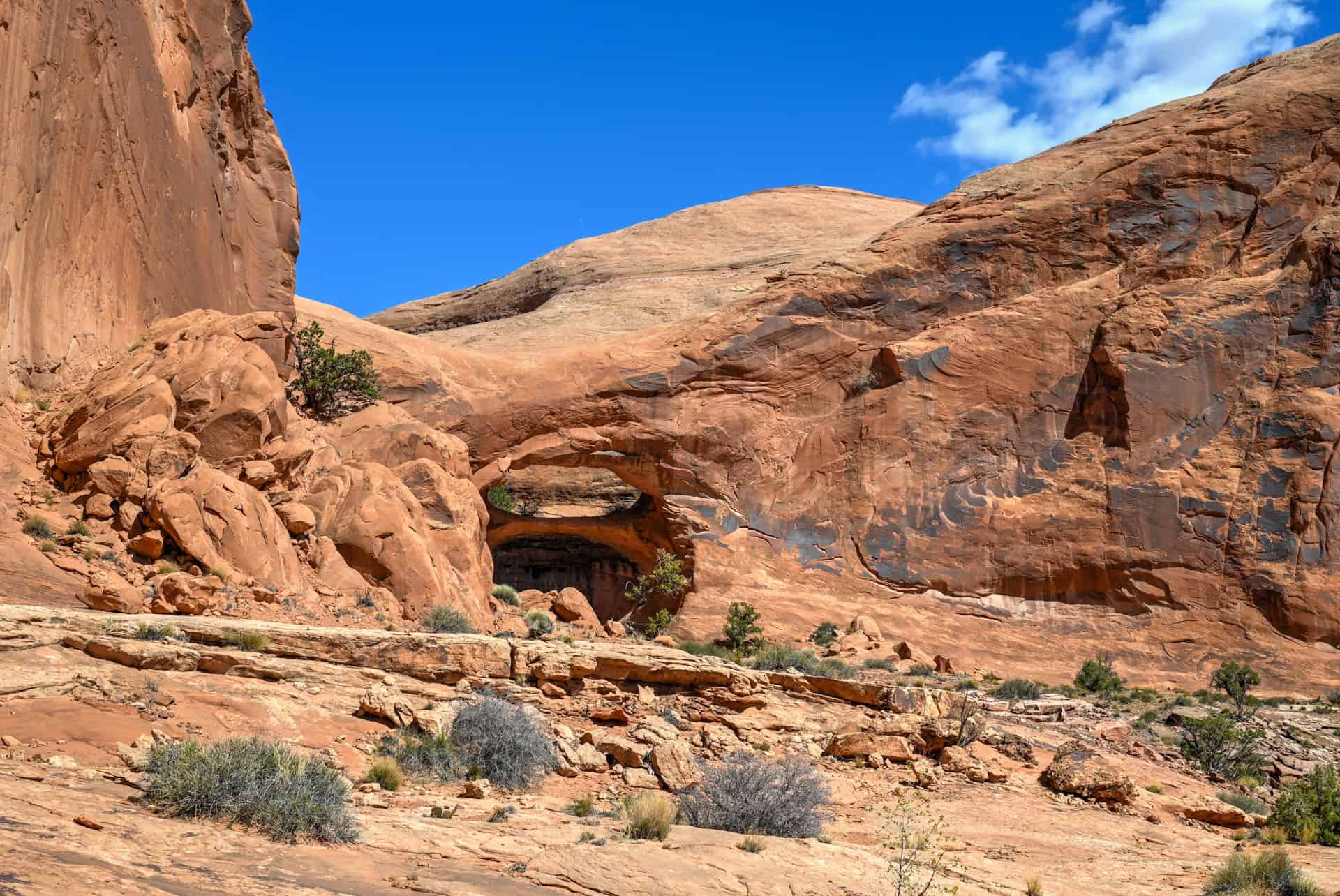
That said, the real highlight is the viewpoint beneath the arch. From here, you get a wide, elevated perspective back toward the Colorado River and the surrounding canyon landscape, one of the better views along the entire hike.


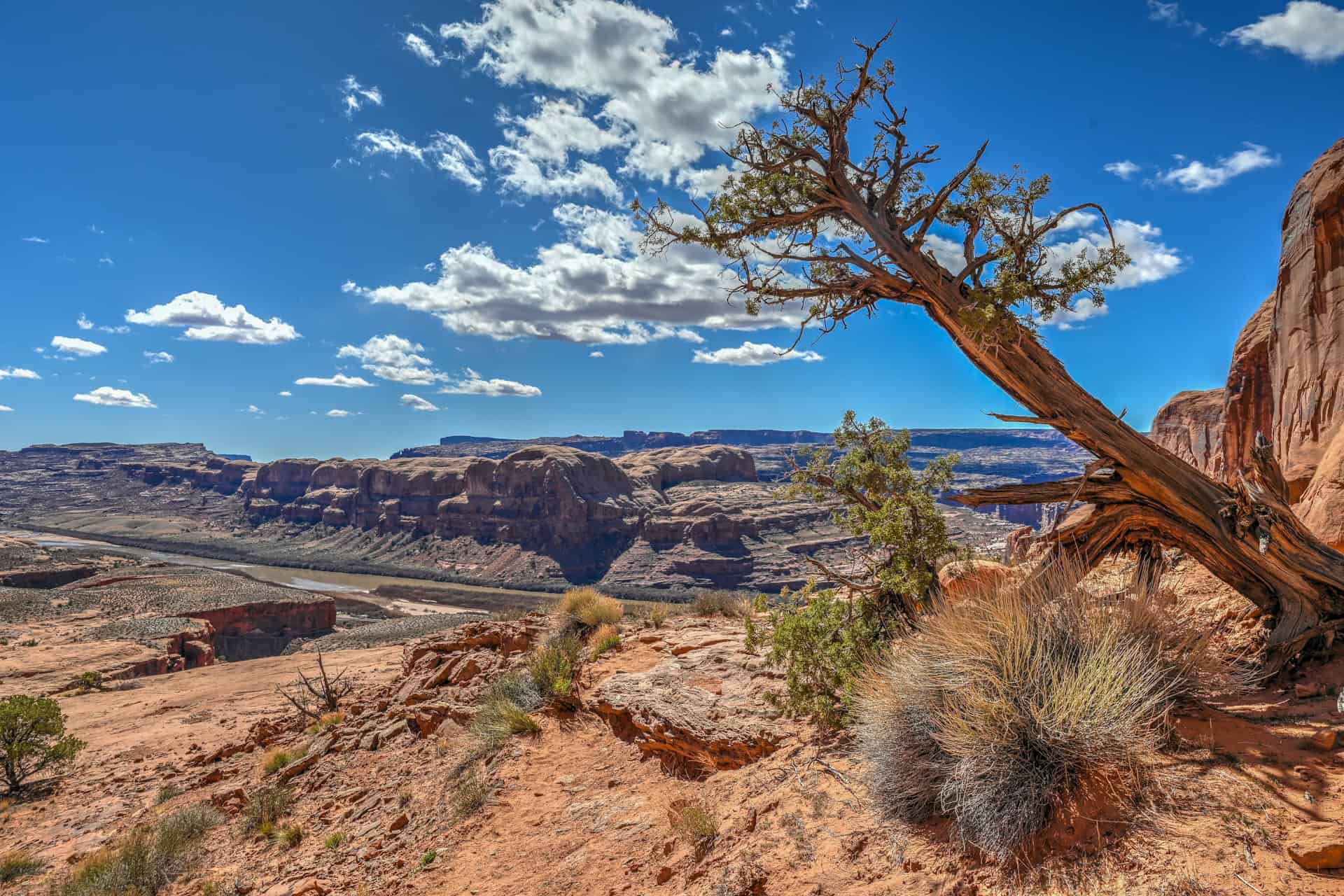
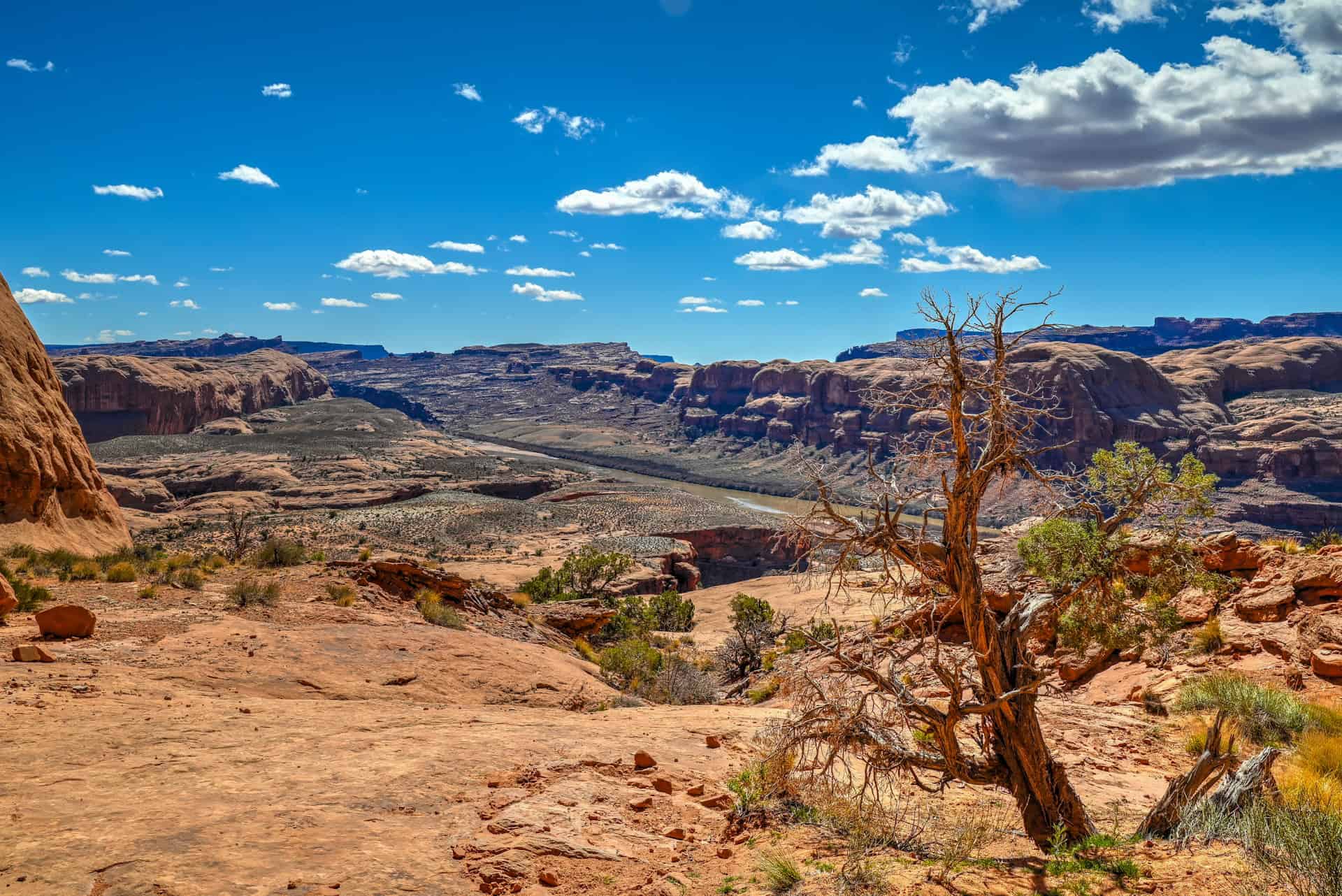
After visiting Pinto Arch, you can either retrace your steps all the way to the main junction or take a slightly shorter connecting path that rejoins the Corona Arch trail.


Trail to Corona Arch
Back on the main trail, the route becomes flatter, crossing open slickrock with fewer elevation changes than the earlier sections.


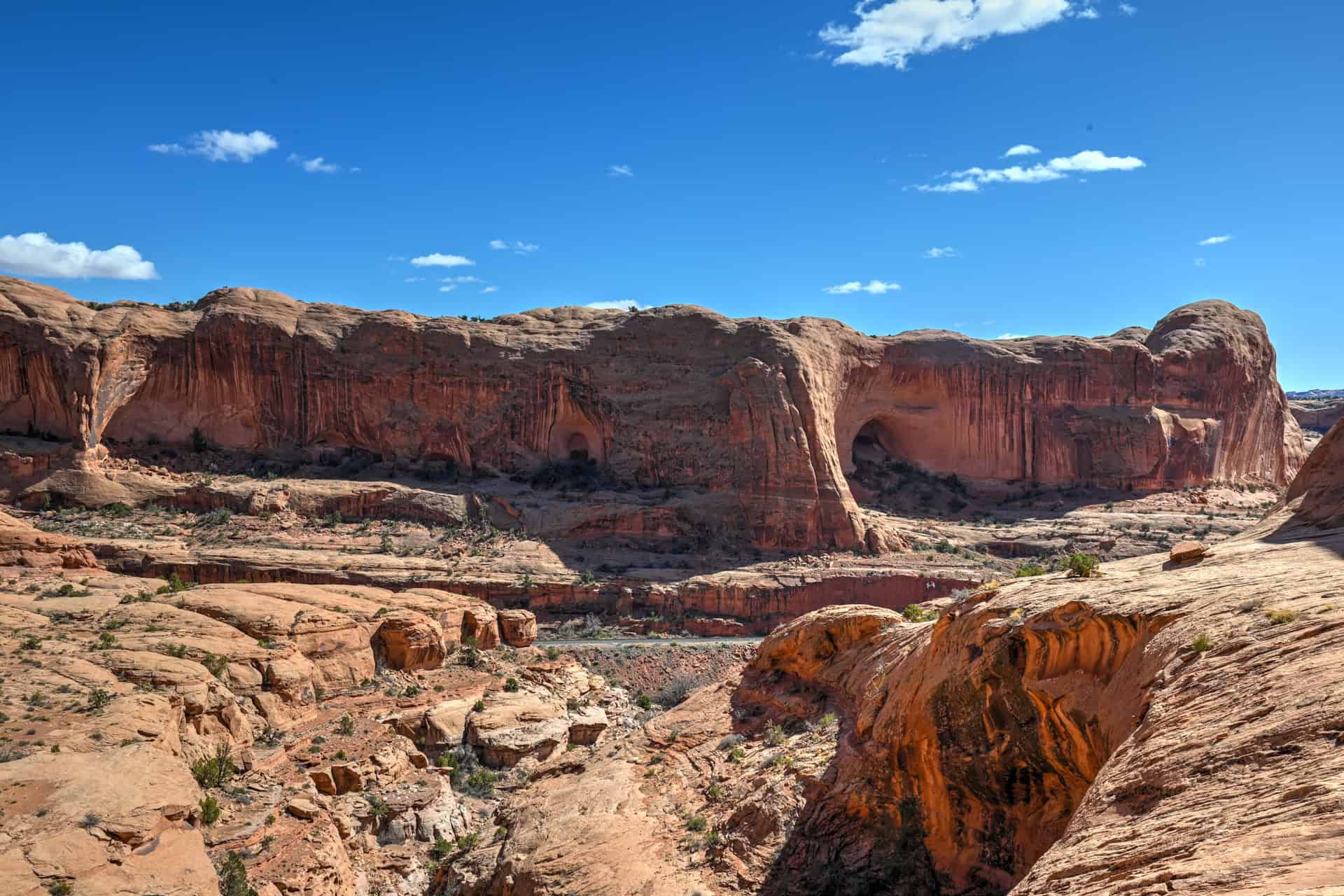
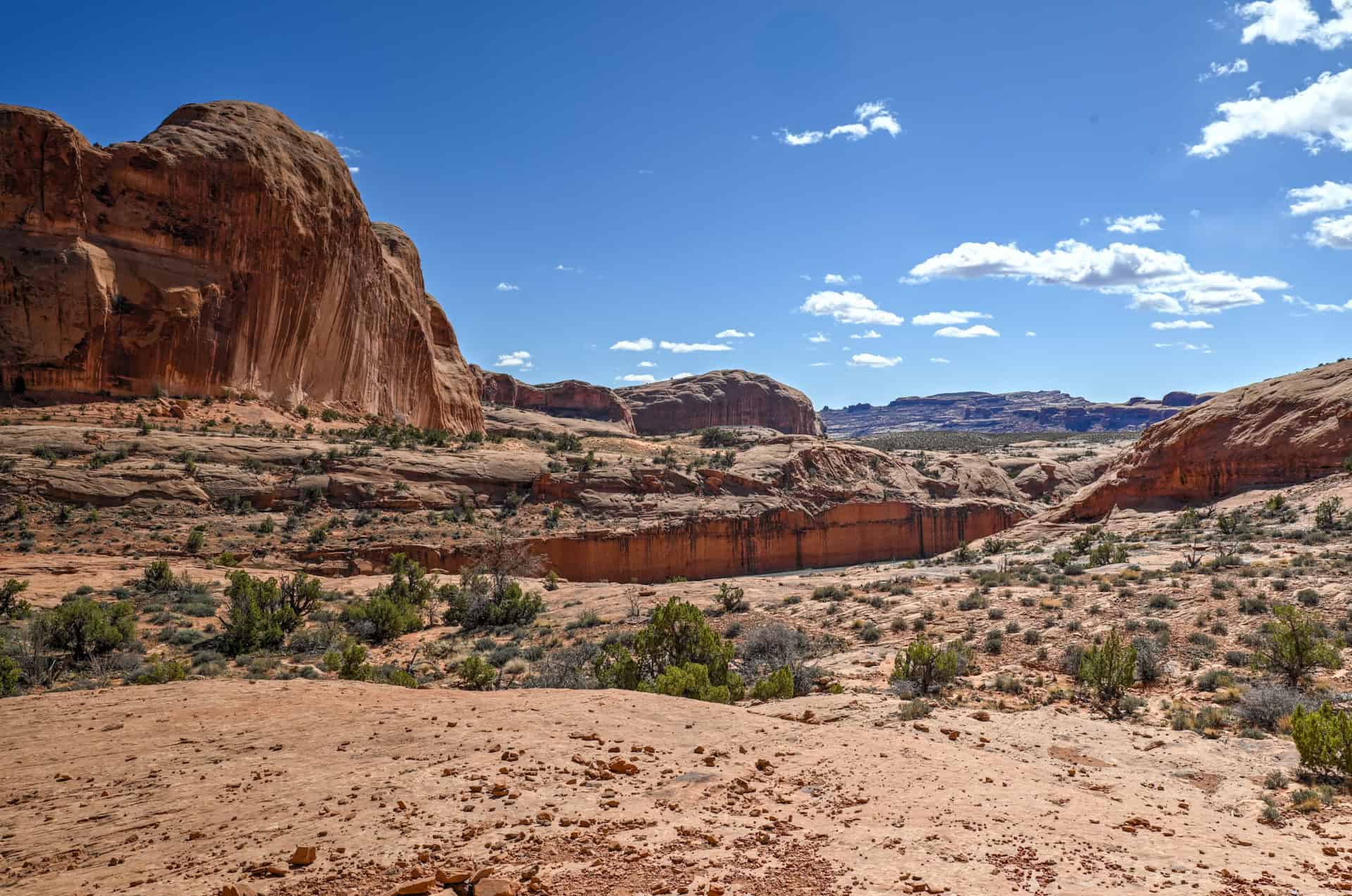
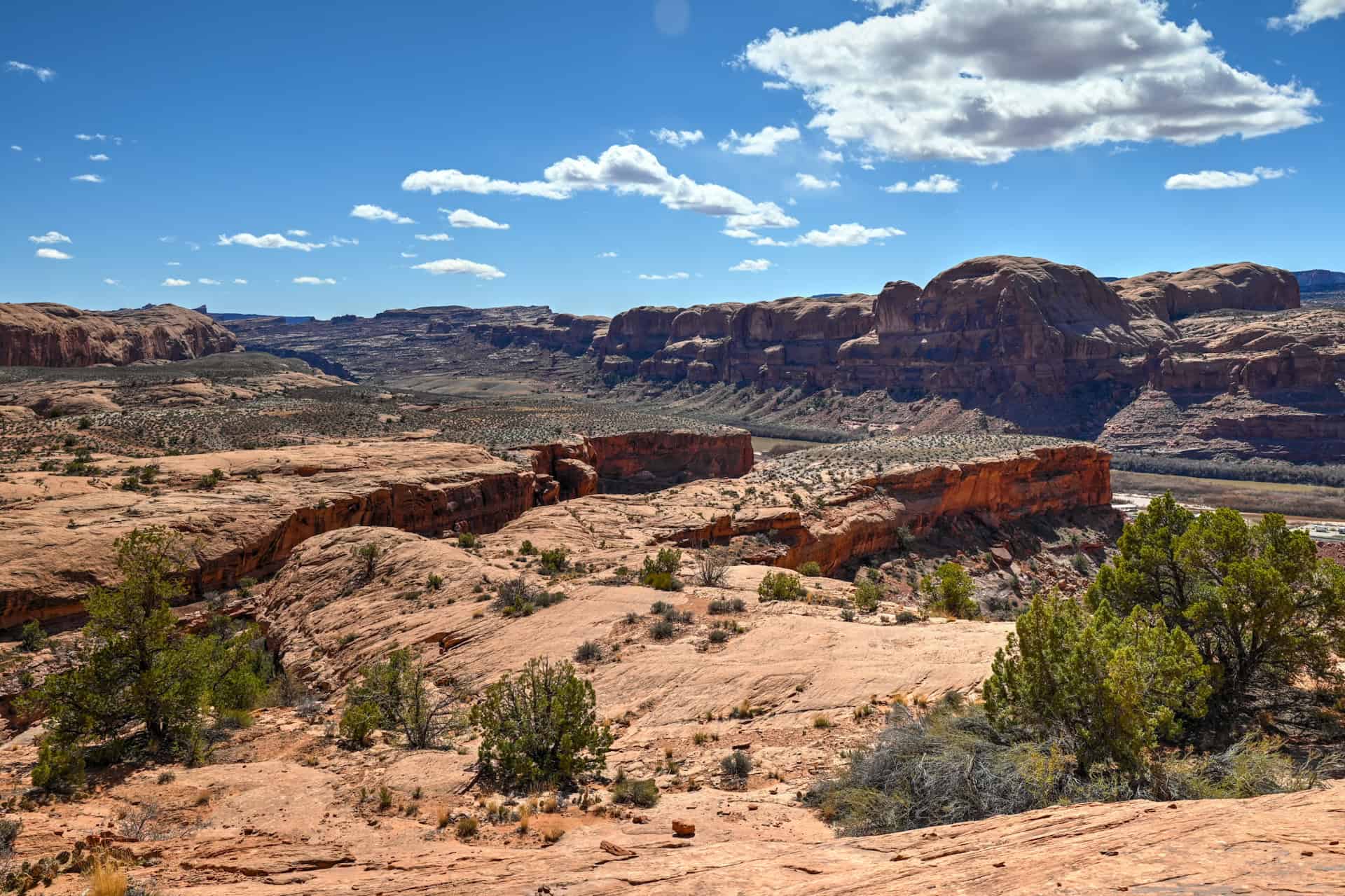
This easier stretch continues until you make a 90-degree left turn and reach one of the trail’s most notable features: a short cable-assisted section followed by a metal ladder.


These sections may seem intimidating, but they are more manageable than they first appear. No special skills are required, and most hikers, including families with children, manage them without much difficulty. That said, they can create brief bottlenecks, especially on the return, as some hikers understandably prefer to take their time descending, which is slightly trickier than going up.
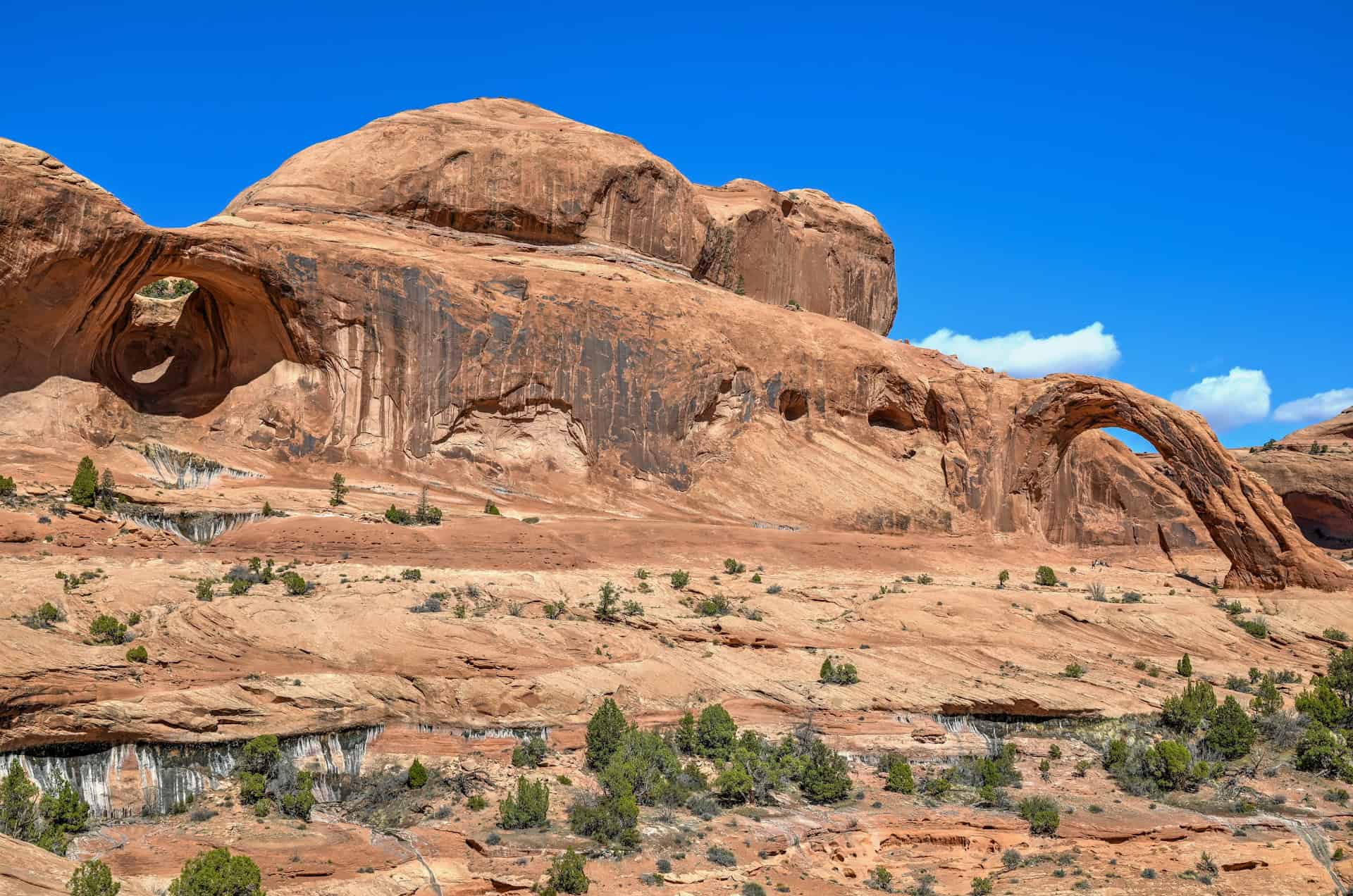
Beyond the ladder, the trail continues across slickrock toward the cliffs ahead, with Corona Arch fully coming into view. Along the way, you’ll pass Bowtie Arch, a large pothole-style arch formed in the rock surface.
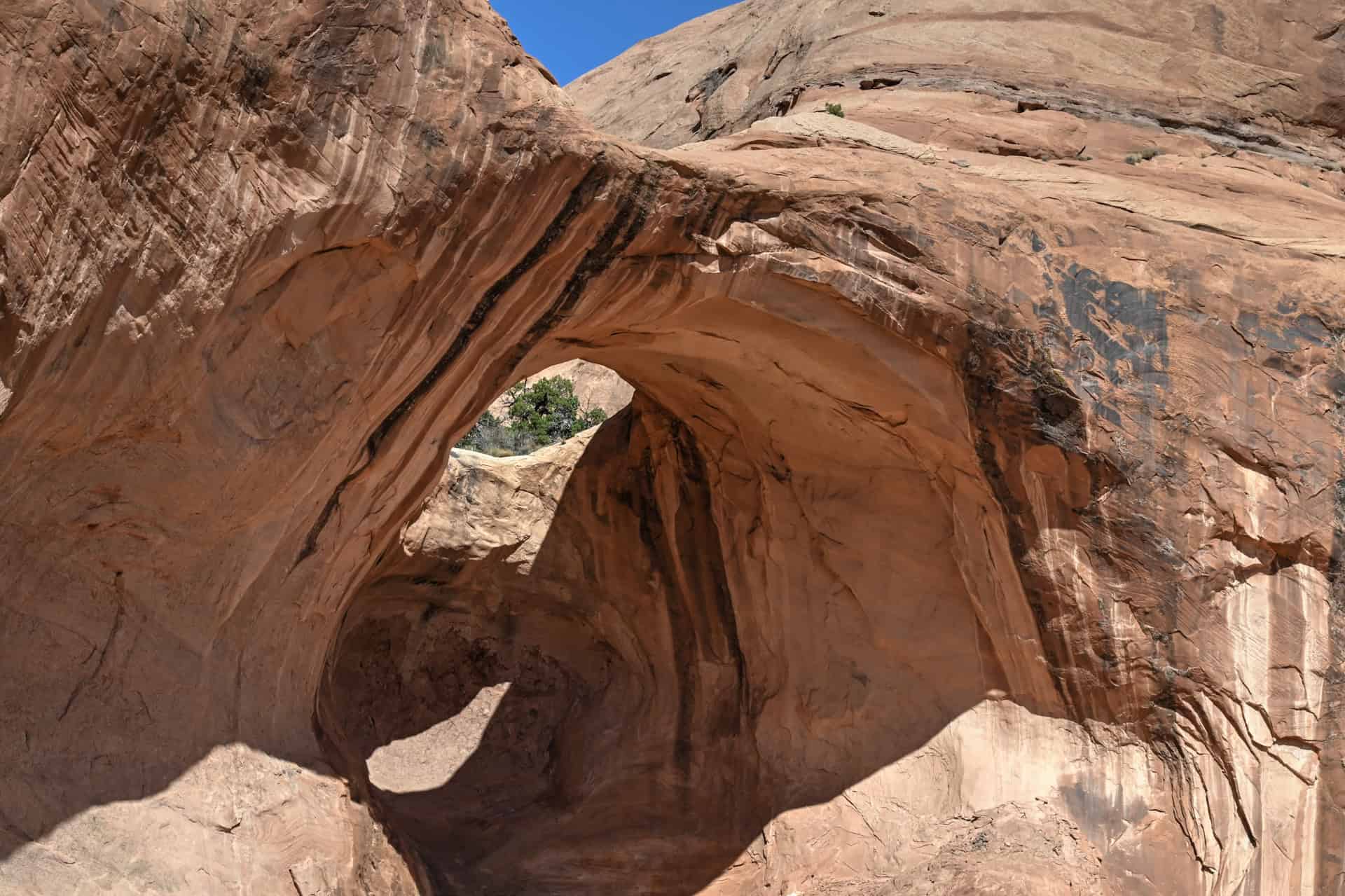
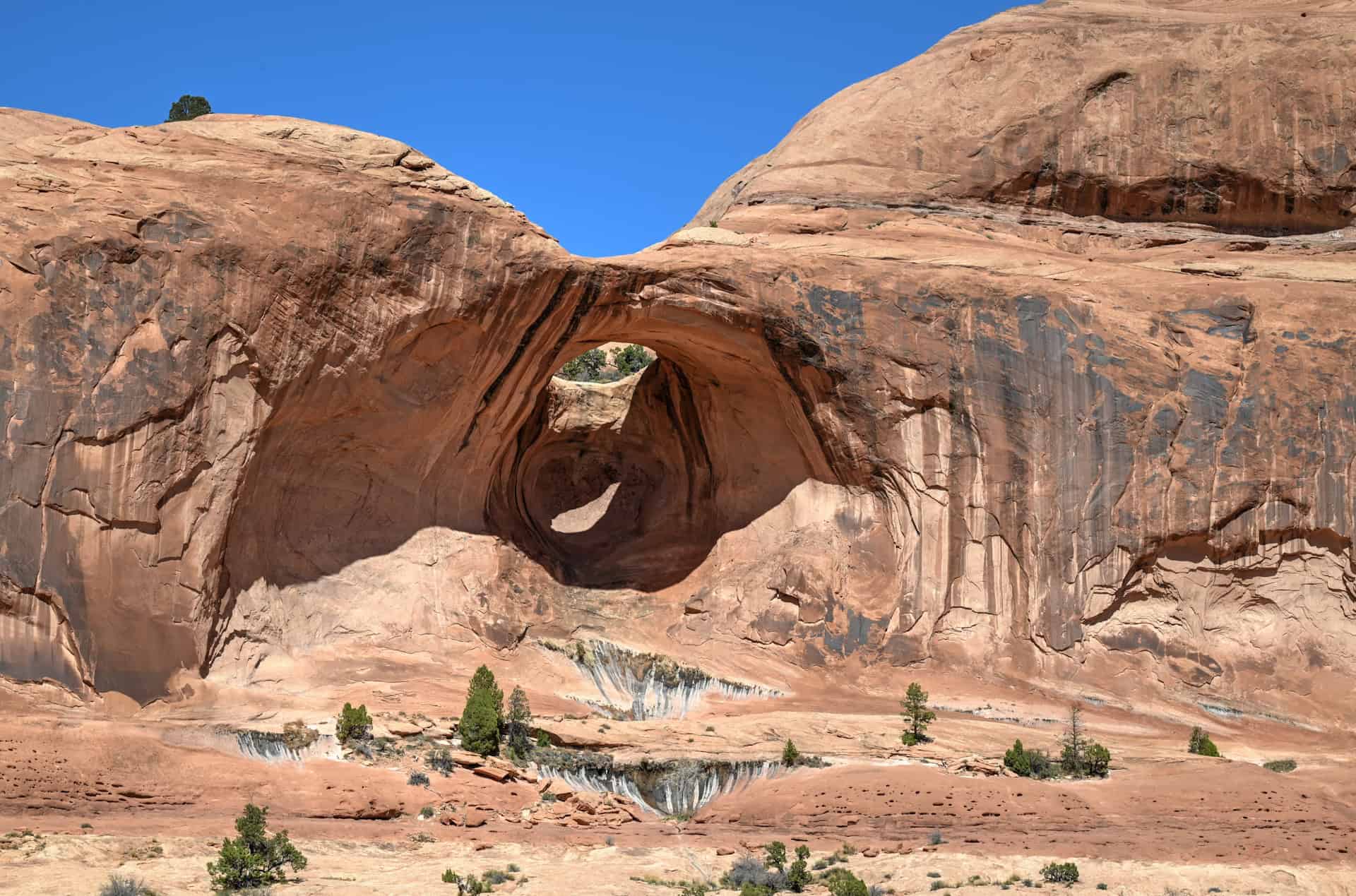
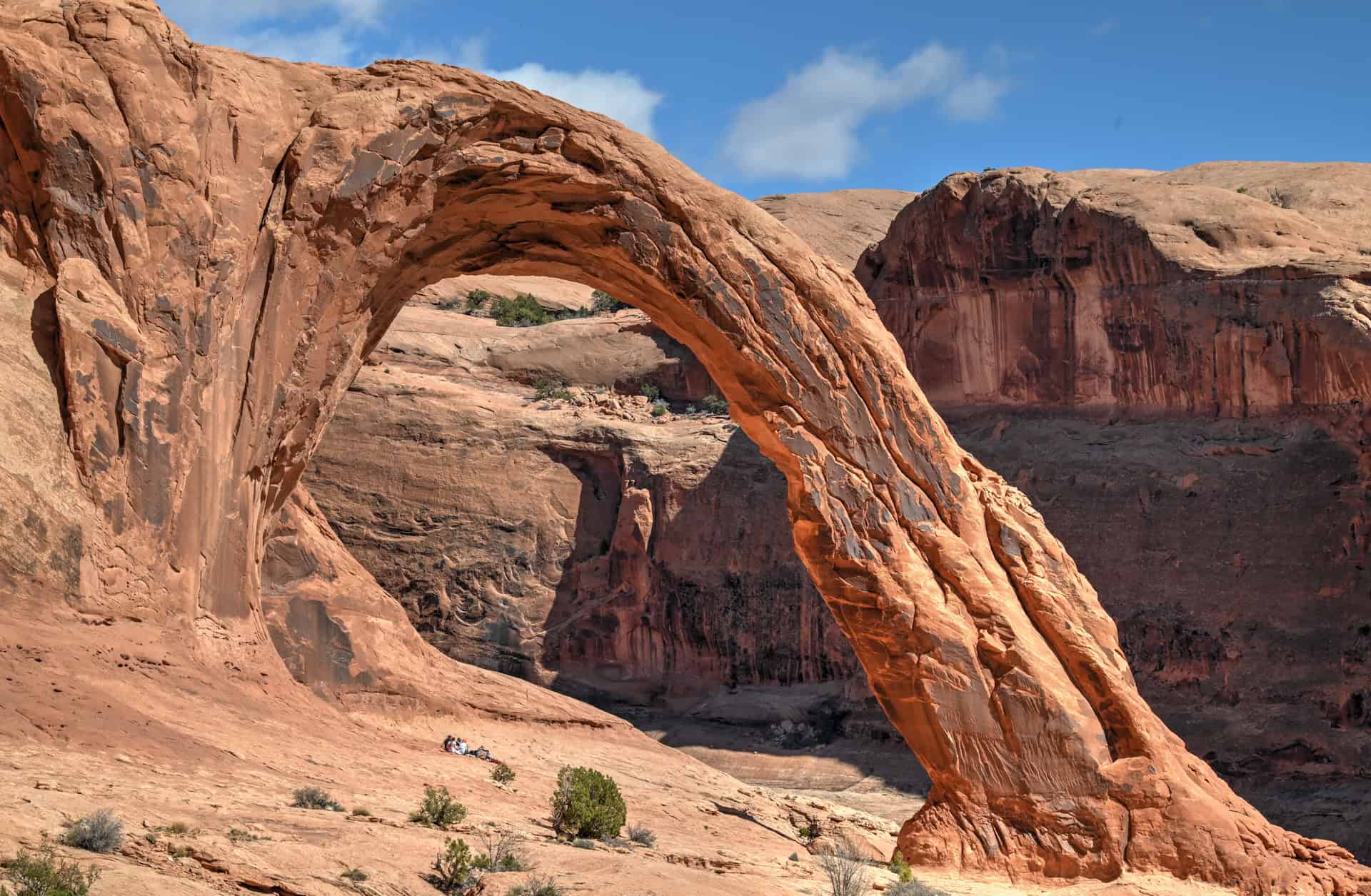
As you near Corona Arch, you’ll be able to appreciate that it is one of the largest arches in the Moab area, with a span of about 140 feet (43 m) and a height of around 105 feet (32 m). Its size and freestanding structure make it comparable to some of the most famous arches in nearby Arches National Park.


The area beneath the arch is wide and open, making it easy to walk around, rest, and take in its impressive size before heading back (notice how small the people under the arch are).
Corona Arch & Pinto Arch Trail – Additional Details and Hiking Tips
Canine companions: Dogs are allowed on this trail, as it is located on BLM land. However, the ladder and cable sections can be difficult for some dogs, and the exposed terrain can become very hot in summer.
Trail environment: The trail crosses open desert terrain along the Colorado River corridor, transitioning from packed dirt to slickrock. Vegetation is sparse, with little to no shade throughout the hike.
Route signage: The trail is well-marked with cairns, painted markers on the slickrock, and clear signage at key junctions, including the split between Pinto Arch and Corona Arch. Navigation is straightforward.
Trail surface / technical aspects: The trail begins on packed dirt and rocky terrain before transitioning to slickrock. No technical scrambling is required, but footing can be uneven, particularly on the steeper sections near the plateau.
Slope and effort: The trail includes a steady initial climb followed by more moderate terrain. The Pinto Arch detour adds additional elevation gain and makes the hike more physically demanding overall.
Previous hiking experience: Suitable for most hikers with basic fitness levels. The ladder and cable sections may look intimidating, but they are short and manageable for most people.
Cable and ladder sections: These are brief but notable features of the hike. The cable helps you cross a sloped section of slickrock, and the ladder assists with a short vertical step. Neither requires technical skill, but both can slow down foot traffic and require some caution, especially on the descent.
Cell service: Reception is limited and unreliable throughout the area. Do not rely on having consistent service along the trail.
Leave No Trace: Stay on marked paths and slickrock to protect fragile desert soil. Avoid climbing on arch formations, and pack out all trash.
Bugs: Insects are typically minimal. Flies may be present in warmer months, but bugs are rarely a major issue.
Equipment: Comfortable hiking shoes with good grip are recommended, especially for slickrock sections. Bring plenty of water and sun protection, as the trail is fully exposed.
Weather and exposure: The trail is exposed to the sun for its entire length. Temperatures can feel significantly hotter, especially on slickrock. After rain, rock surfaces may become slippery.
Current Trail Conditions: Check the National Park Service alerts page for Canyonlands National Park before your visit for updates on weather, closures, or temporary restrictions.
Hiking Packing List
All Trails subscription – This comes in really handy for areas with little or no cell reception, as the annual subscription allows you to download trail maps for offline use.
External Battery – If you are using your phone to track your progress along the trail or to help with navigation, you certainly don’t want your phone to die on you. That’s especially true in the unlikely event that you might get hurt or need assistance.
Hiking poles – These can be particularly useful in steep trails or muddy/boggy trail conditions.
Water Filter Bottle – The Life Straw bottle is an advanced water bottle with a filter that not only improves water taste but more importantly filters out bacteria and parasites, chemicals and microplastics.
Headlamp – very practical and a smart choice if you plan to start your hike before sunrise or finish it after sunset.
Best Time to Hike the Corona Arch & Pinto Arch Trail
Best Time of Day
Early morning (best for hiking conditions)
Early morning is one of the best times to hike this trail. Temperatures are cooler, the trail is quieter, and the initial climb is much more manageable without direct sun exposure.
Lighting is softer at this time, and while the arches are not fully illuminated, the surrounding landscape still looks good.
Late afternoon to sunset (best for lighting on the arch)
Late afternoon is ideal if your goal is to see Corona Arch in its best light. The arch faces generally west, and warm evening light enhances the color of the rock as the sun lowers.
This is also one of the more popular times to visit, especially for photography. If you time it well, you can reach the arch as the light becomes more directional and stay through sunset.
Midday (least recommended)
Midday is the least favorable time to hike. The trail is fully exposed, and temperatures can feel significantly hotter, especially on slickrock. Lighting is also flatter and less interesting for photography.
Best Seasons
Spring and fall offer the most comfortable hiking conditions, with moderate temperatures and generally stable weather. These are also the busiest times in the Moab area.
Summer can be very hot, particularly in the middle of the day. If visiting in summer, hiking early in the morning or later in the afternoon is strongly recommended.
Winter is quieter and can be a good time to visit. Temperatures are cooler, though mornings can be cold. Snow and ice are uncommon but possible, and can make slickrock sections more slippery.
Quick Summary – When to Visit
The Corona Arch & Pinto Arch Trail is best hiked early in the morning for cooler temperatures or in the late afternoon for better lighting on the arch. Midday is best avoided due to heat and full sun exposure.
Is the Corona Arch & Pinto Arch Trail Worth It?
We definitely think so! The Corona Arch Trail is one of the best hikes near Moab, offering a large, freestanding arch that rivals many of the formations found in Arches National Park — without the need to enter the park.
The hike itself adds to the experience. The mix of terrain, short climbs, and features like the ladder and cable sections makes it more engaging than a typical desert walk, while still remaining accessible to most hikers.
Pinto Arch is more of a bonus than a main highlight. While it’s worth the detour if you have the time and energy, most visitors will find that Corona Arch is the clear standout of the hike.
Why You Might Enjoy It:
– One of the largest and most impressive arches in the Moab area
– Interactive hike with varied terrain, ladder, and cable sections
– No park entrance fee or timed reservation required
– Great views along the way and at the arch itself
– Pinto Arch adds an optional extension for those wanting a longer hike
Why It Might Not Be for You:
– Can be busy, especially in the late afternoon and at sunset
– Fully exposed to the sun with little to no shade
– The ladder and cable sections may feel intimidating to some hikers
– Pinto Arch is less visually impressive than Corona Arch
Bottom line: If you’re looking for a rewarding hike near Moab that combines a bit of variety with a major natural landmark, the Corona Arch Trail is absolutely worth it. Pinto Arch is a worthwhile add-on, but Corona Arch is the main reason to do this hike.
Want to Explore More Hikes around Moab?
If you’re planning more hikes in the area, we’ve put together a complete guide to the Best Trails around Moab. It covers a mix of routes across BLM land as well as hikes in nearby parks like Arches National Park, Canyonlands National Park, and Dead Horse Point State Park, from short viewpoint walks to longer slickrock and canyon hikes.


Where to Stay in Moab
Moab serves as the main base for exploring the region, including nearby areas like Arches National Park, Canyonlands National Park, and Dead Horse Point State Park. The town offers a wide range of accommodations, from national hotel chains to smaller motels and locally run lodges.
Staying in Moab makes it easy to:
– Reach trailheads like the Corona Arch Trail within minutes
– Access both national parks early in the morning
– Choose from a wide range of restaurants, grocery stores, and outdoor outfitters
– Book guided tours, rentals, and other activities in the area
Below are three well-located, reliable options at different mid-range price points and styles.
La Quinta Inn & Suites by Wyndham Moab
Best for: Comfortable, reliable mid-range stay with strong value
La Quinta offers a familiar, dependable experience with spacious rooms, a large outdoor pool, and complimentary breakfast. It’s located along the main highway entering Moab, about 10 minutes from the Arches entrance.
Why it works well:
- Good value relative to other Moab hotels
- Large parking area (useful for larger vehicles or road trips)
- Easy access in and out of town
This is a solid choice for families, road trippers, or anyone prioritizing comfort and practicality.
Best for: Modern amenities close to Arches
Wingate is one of the newer properties in Moab and sits slightly north of town, closer to the entrance of Arches. Rooms are modern and well-appointed, and amenities include a pool, fitness center, and free breakfast.
Why it stands out:
- Shorter drive to Arches (ideal for early starts)
- Newer build with a contemporary feel
- Reliable comfort without boutique pricing
If your priority is minimizing drive time into the park, this is one of the most convenient options.
Best for: Outdoor-focused travelers and an adventure vibe
Field Station blends hotel comfort with a gear-friendly, adventure-oriented design. The property includes communal gathering spaces, bike storage, and a laid-back atmosphere that caters to hikers, climbers, and mountain bikers.
Why people love it:
- Clean, minimalist rooms
- Social outdoor areas
- Feels aligned with the Moab adventure culture
It’s ideal if you want something more distinctive than a traditional chain hotel without sacrificing comfort.
A Quick Planning Tip
Moab fills quickly during spring and fall, especially March through May and October, so booking in advance is strongly recommended. Summer availability is often easier, but rates can still be high during peak travel periods.
Corona Arch & Pinto Arch Trail – Frequently Asked Questions (FAQ)
How hard is the Corona Arch Trail?
The Corona Arch Trail is generally considered easy to moderate. The distance is manageable, but the hike includes a steady climb at the beginning and a few features, like a ladder and a cable section.
Is the ladder or cable section difficult?
Not really. Both are short and manageable for most hikers. The cable helps you cross a sloped section of slickrock, and the ladder assists with a short step up. They can feel more intimidating than they actually are.
Is the Corona Arch Trail suitable for families?
Yes. Many families hike this trail with children. The ladder and cable sections may require some assistance for younger kids, but they are generally manageable.
Is Pinto Arch worth the detour?
It depends. Pinto Arch is quieter and offers a nice viewpoint, but it is less visually impressive than Corona Arch. If you have the time and energy, it’s a worthwhile addition, but it’s not essential.
Is the Corona Arch Trail crowded?
It can be busy, especially in the late afternoon and around sunset. However, it is generally less regulated and less congested than hikes inside nearby parks like Arches National Park.
Can you see the Corona Arch without hiking?
No. A hike is required to reach the arch, but the trail is relatively short and accessible.
Are dogs allowed on the trail?
Yes. Dogs are allowed, but the ladder and cable sections can be difficult for some dogs, and the exposed terrain can be very hot.
Are drones allowed?
Drones are generally allowed on BLM land, but regulations can vary. Always check current rules and be respectful of other visitors.
Explore More Utah National & State Park Guides
Continue exploring Utah with these detailed guides:
Zion National Park Guide
Bryce Canyon National Park
Goblin Valley State Park Guide
Monument Valley Guide
Arches National Park
Canyonlands National Park
Photography Gear
If you like our photography, you might be interested in some of the gear we use to shoot our travel and hiking destinations.
Camera Body – Nikon Z 6ii Fx-series Mirrorless Body
Main Lens – NIKON 24-120mm F/4G ED VR AF-S
Zoom Lens – Sigma 745-306 150-600mm f/5-6.3
Polarizing filters – Urth Circular Polarizing (CPL)
Camera Tripod – K&F Concept 64-inch Camera Tripod
Mini-tripod – Lammcou Flexible Camera Tripod
Camera/hiking backpack – Vanguard Alta Rise 48 Backpack
Universal Travel Adapter – VYLEE Universal International Power Travel Plug
Other Travel Essentials
Travel Insurance
SafetyWing is a travel insurance company that offers comprehensive coverage for travellers. Includes Medical Insurance and Travel Insurance. Primarily geared towards long-term travellers, digital nomads, and expats.
e-Sim cards
Airalo is the world’s first and largest eSIM store with eSIM plans for 200+ countries and regions worldwide. With Airalo eSIMs, travellers can get connected the moment they land at their destination and avoid nasty data roaming charges
eSIMS are a sustainable alternative to single-use SIM cards – they are 100% digital, require less energy to produce and be re-used rather than disposed of.
Car Rentals
Discover Cars is our go-to website for car rentals. We almost always find our preferred rate there.
Transfer from Airport
Welcome Pickups is our favourite private transfer service, which you can pre-book at a fixed price. Currently available in 220 cities all over the world (mostly in Europe, but with several major cities in Asia, the Middle East and the US).
Kiwitaxi is another private transfer service – we haven’t tried it yet, but it’s currently available in a few more countries (102 as of 2024).
Hotels and Accommodations (coming soon)
Photography Prints
If you found this blog useful, you can help support our blog by purchasing low-cost digital prints. Printed physical prints are also available for purchase.


—–
Well, that wraps it up! We hope you enjoyed our Moab Hiking Guide for the Corona Arch & Pinto Arch Trails and that it will prove useful for planning your trip.
—–
You might also be interested in these related pages: